
AssignmentGPT Blogs

Why Students Are Switching to AI Homework Helpers

Get an AI summary of this post on:





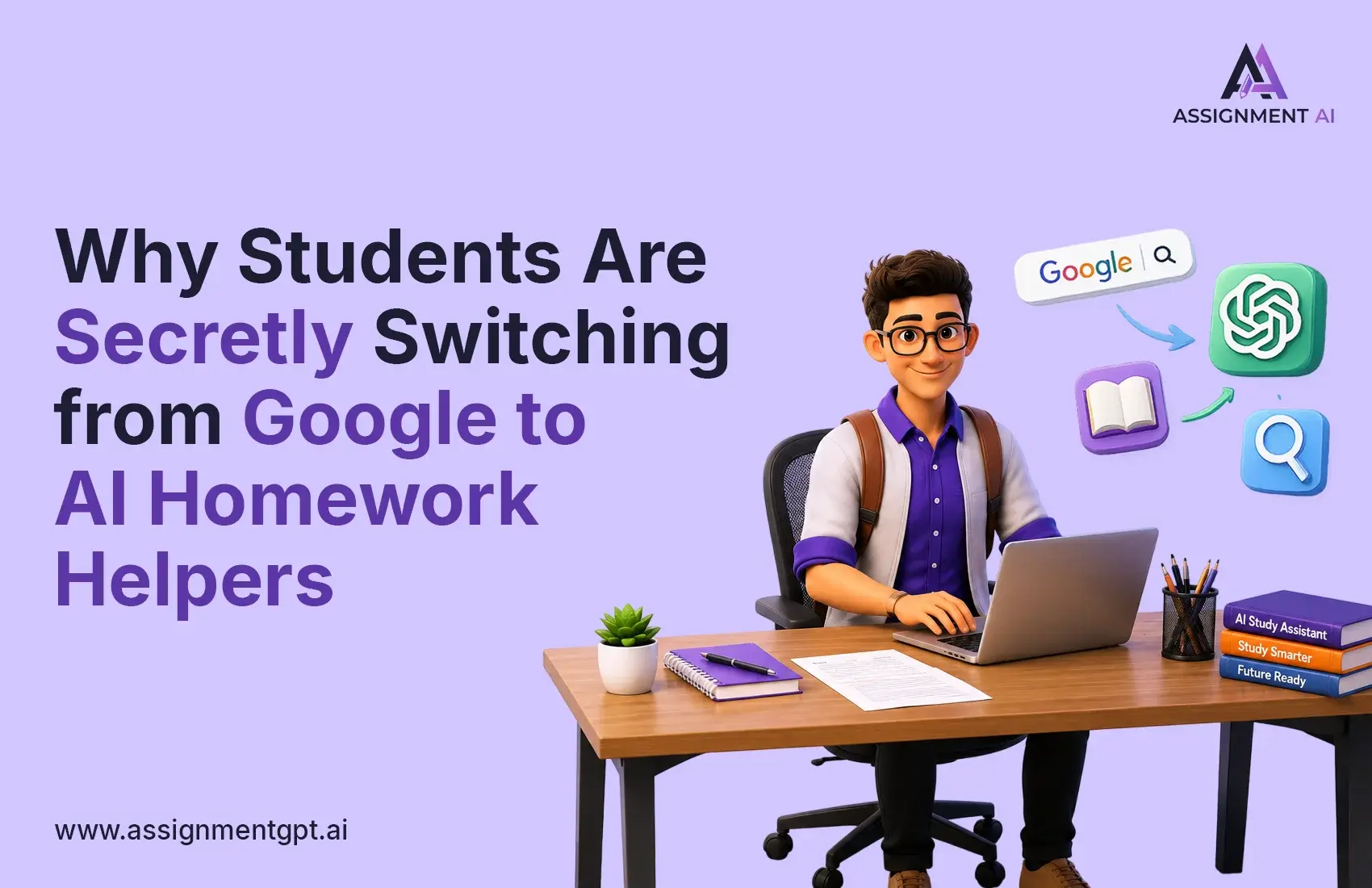
Students are not just using Google anymore; across middle schools, high schools, and colleges, a quiet shift is happening. AI homework helpers are kinda replacing the old search engines for academic tasks, in a way that feels casual but also kind of big.
According to a 2026 RAND report, the share of students using AI for homework jumped from 48% to 62% in only seven months. In this article, we break down why this shift is underway, what it means for learning, and how educators should respond, especially in classroom routines that used to rely on searching.
If you want to get a clearer picture of where student learning is heading next, you can also browse financial and academic planning resources at Dhanarthi.com.
The Rise of AI Homework Helpers
Growth of Homework Helper AI Platforms
AI homework helpers kinda grew from niche tools to more mainstream study companions, you know. Nowadays, platforms powered by large language models do a whole lot, like from essay drafting and even solving math problems, which is, honestly, more normal than before.
- ChatGPT alone is used by 53% of students for school-related tasks
- Google Gemini usage more than doubled between May and December 2026
- 71% of students now use at least one AI tool for academic work
The growth is not slowing down. It is accelerating.
AI Tools for Students in Daily Study
AI tools for students are getting used in all sorts of everyday school things. It is not just one-off, random occasions either, it keeps happening day after day, and that kind of matters too.
Common daily uses include:
- Getting clearer explanations of difficult assignments (38% of students)
- Brainstorming ideas for essays or projects (35%)
- Looking up facts and doing quick research (33%)
- Drafting and revising written work (33%)
Students find AI faster, more conversational, and more helpful than traditional search.
Changing Student Learning Behaviors
The way students approach learning has fundamentally changed. Where students once opened Google, they now open ChatGPT or some similar thing. They type questions in everyday language and expect direct, chatty answers.
Honestly, this is not just a simple preference shift. It is a behavioral change powered by the efficiency and the interactive feel that AI gives, compared with keyword-based searching.
Why Students Use AI Tools Instead of Google
Faster Answers Through AI Assistance
Google returns links, AI returns answers
When a student asks, "How does photosynthesis work?", Google shows ten links. That needs to be clicked and read. But an AI tool gives a clear, structured explanation in seconds, like magic almost. For time-pressed students, is this difference really a matter, a lot?
Speed is one of the main reasons learners are moving from Google to homework helper AI platforms, so they can get on with the actual assignment without wasting minutes.
Personalized Support for Homework Tasks
AI adapts to the student, somehow. Google does not.
A student can tell an AI tool, "Explain this like I am in 8th grade," or "Give me three examples of this concept using sports." The AI tweaks its tone, depth, and maybe even the examples to fit how the learner thinks. Google can't really do that.
That personalization makes AI tools for students feel less like some search engine and more like a quiet personal tutor, or something along those lines.
Interactive Learning Beyond Search Results
With Google, it kinda ends as soon as you click a link. With AI, it keeps going and going. You can ask follow-up questions, ask for a simplification, or wander into related ideas without having to do a brand new search. That back and forth conversation builds a deeper understanding, in a way that a simple list of links just can't really copy.
Google vs AI Homework Helpers
Differences Between Search and AI Tools
| Feature | Google Search | AI Homework Helpers |
|---|---|---|
| Response format | Links | Direct answers |
| Personalization | None | High |
| Follow-up interaction | Not possible | Fully supported |
| Context retention | No | Yes (within session) |
| Speed of useful answer | Slower | Faster |
The comparison makes it clear why students are shifting, as I mean, they are doing it more and more. Google vs AI homework helpers is not really a competition anymore for conversational academic tasks, not in the old way.
Accuracy and Context in AI Responses
AI tools tend to give contextual answers, not simply keyword matching. They basically "get" the intent behind a question and then respond accordingly, like it has a real thread, even if it's not perfect.
However, it's also true that AI is not always accurate. It can end up producing incorrect info, especially when the topic is niche or when the event is pretty recent. So students should be trained to verify anything AI-generated, using trusted sources and a bit of common sense, too.
Student Preferences in Homework Research
Research confirms the shift in student preferences:
- 84% of high school students reported using AI tools for schoolwork as of May 2025
- 69% specifically used ChatGPT for homework assignments
- Students preferred AI for tasks involving writing, research, and concept explanation
The numbers show that students using AI for homework is no longer a trend. It is the new normal.
Students Using AI for Homework
Common Ways Students Use AI Tools
Students using AI for homework rely on these tools in several consistent ways:
- Getting step-by-step explanations for math and science problems
- Generating essay outlines and first drafts
- Summarizing long readings and textbook chapters
- Checking grammar and improving writing quality
- Preparing for exams through AI-generated practice questions
Each of these tasks used to need a few different tools, or just a lot of significant time. But AI kind of bundles all of it into a single interface, which makes it feel a bit effortless. Instead of hopping around, you get it all in one place.
AI Support for Writing and Research
Writing is one of the most common use cases. Students ask AI to:
- Suggest thesis statements
- Improve paragraph structure
- Paraphrase complex ideas in simpler language
- Recommend research directions
For research, AI helps students identify key angles before they dive into sources. This makes the research process faster and more focused. Students who want to go further can also explore how to write an essay using AI tools to get more structured guidance.
Homework Completion With AI Assistance
AI has basically reduced the time students spend on routine homework a lot. Things that used to take an hour might now take around 20 minutes if AI is helping. And this sort of brings up these key questions, like what are they really absorbing. Because when the AI ends up doing the mental grind and the cognitive work, the student can finish the assignment, but not actually grasp what the topic is about.
Benefits of AI Tools for Students
Improved Productivity for Students
AI tools for students significantly improve academic productivity. They reduce time spent on repetitive tasks, allowing students to focus on deeper understanding and creative thinking.
For students managing heavy workloads, AI assistance can reduce stress and help them meet deadlines without sacrificing quality. Exploring the best AI productivity tools can help students find the right fit for their study style.
Better Accessibility in Learning Support
AI removes barriers that traditional tutoring cannot. A student without access to a private tutor can now get detailed, patient explanations at any hour of the day for free or at low cost.
This democratizes academic support and gives every student access to the kind of personalized help that was once only available to the privileged few.
Personalized Academic Assistance Features
Modern AI homework helpers offer features specifically designed for students:
- Step-by-step problem solving
- Multiple explanation styles (visual, conceptual, numerical)
- Language support for non-native speakers
- Instant feedback on written work
- Subject-specific tutoring modes
These features make AI not just a shortcut, but a genuine learning tool when used responsibly.
Risks of Homework Helper AI Usage
Concerns About Academic Integrity
The most talked about risk is academic dishonesty, honestly. A 2025 RAND survey found that 45% of students believe using AI for straight-up answers is cheating, but still a lot of them do it anyway.
There's this blurry line between help and dishonesty. Like, using AI for brainstorming is pretty widely accepted. But having AI actually write a full essay, that's where it changes. Schools really need clearer policies so everyone can see the boundary, and not feel like it's "kind of" allowed. Students can also read more about whether using AI is considered cheating and how to use it ethically.
Overreliance on AI Study Assistance
In 2025, 67% of students said that heavy AI use harms critical thinking skills. And still, use kept climbing. That little contradiction points at a genuine risk, students seem to know dependency is an issue, but they can't really resist it for long.
When students stop tackling hard problems on their own, they lose the mental workout that actually builds real capabilities. Real learning needs some friction, effort, and yes an occasional failure.
Data Privacy and Student Protection
Many AI tools collect user data. Students, especially minors, may not understand what they are agreeing to when they use these platforms.
Schools and parents must ensure students use privacy-respecting AI tools and understand the implications of sharing their academic work with AI systems.
How Educators Should Respond
Teaching Responsible AI Usage Skills
Educators should treat AI literacy as a core academic skill, not a threat to manage. Students need to learn:
- How to evaluate AI-generated content critically
- When to use AI as a starting point, not an endpoint
- How to cite AI assistance transparently
Just as calculators changed math instruction, AI must change how educators design assignments and assessments. A closer look at how AI transforms education can give teachers a broader perspective on this shift.
Creating Policies for AI in Education
Schools need clear, consistent AI policies. These should specify:
- Which tasks AI assistance is permitted for
- How students should cite AI usage
- Consequences for unauthorized AI use
Policies should be developed collaboratively with students, not imposed on them. Students who understand the reasoning behind rules are more likely to follow them.
Supporting Ethical Student Learning
Ethical AI use in education means using AI to enhance learning, not replace it. Teachers can structure assignments around this principle by:
- Requiring students to explain AI-generated content in their own words
- Building in reflection steps after AI-assisted tasks
- Creating in-class assessments that cannot be AI-assisted
The best ways teachers can use AI in the classroom offer practical strategies that support both innovation and integrity.
Future of AI Homework Helpers
Educational AI is moving fast, kinda beyond just being a tool for simple homework help. The next generation of AI powered learning systems should become really built into digital classrooms, and also into learning management platforms. Rather than having separate AI apps, students might soon talk to an AI right inside their school portals, assignments, and collaborative learning spaces. At that point the AI feels like a steady learning companion, not just a random productivity thing you use once in a while.
A big shift will be personalized AI tutoring systems. These systems will watch how a student learns, what they're strong at, where they struggle, and how everything is progressing over time, then it will deliver customized explanations and maybe even study strategies that fit that learner more closely. Platforms already exploring this direction are shaping what the next generation learning tool will look like for students everywhere.
Conclusion
The shift from those old-school search engines like Google to AI homework helpers is speeding up across modern education. Students are starting to pick AI tools more often because they give quicker answers, more tailored explanations, a kind of interactive mentoring, and even a step-by-step assist that regular search results usually cannot match. Honestly, this change isn't temporary or like a short phase.
For educators, the bigger problem isn't really if students will use AI anymore. It's more like how schools can steer responsible, productive AI use inside the learning environment, in a way that still supports real understanding and learning.
FAQs
1. What are AI homework helpers and how do they work?

2. Are AI tools for students better than Google for homework?
3. Is using AI for homework considered cheating?
4. What are the most common ways students use AI for homework?
5. Can AI homework helpers hurt student learning in the long run?
6. Which AI tools are most popular for student homework help?
7. How is AI for homework different from a regular search engine?
8. What should students watch out for when using AI homework tools?
9. How should teachers handle students using AI for schoolwork?
10. Will AI homework helpers replace traditional studying in the future?
Digital Marketer | SEO
I’m Dipak Dangodara, the SEO Expert at AssignmentGPT AI. I manage and optimize the website’s search engine presence with a strong focus on organic growth, visibility, and performance. My work includes technical SEO, keyword research, on-page and off-page optimization, and tracking SEO performance to align with search engine best practices.
At AssignmentGPT AI, my goal is to build sustainable rankings, improve traffic quality, and ensure the platform delivers long-term value through effective SEO strategies.
Master AI with
AssignmentGPT!
Get exclusive access to insider AI stories, tips and tricks. Sign up to the newsletter and be in the know!
Transform Your Studies with the Power of AssignmentGPT
Empower your academic pursuits with tools to enhance your learning speed and optimize your productivity, enabling you to excel in your studies with greater ease.
Start Your Free Trial ➤Related Articles
Free vs Paid AI Homework Tools for Students in 2026
Compare free and paid AI homework tools in 2026 to find the best option for saving time, money, and improving study support.

10 AI Tools Every College Student Should Use in 2026
Discover 10 powerful AI tools every college student should use in 2026 to study smarter, save time, boost productivity, improve learning, & achieve better grades.
AssignmentGPT AI Citation Generator: Format Citations Fast
Create accurate APA, MLA, Chicago, and Harvard citations instantly with AssignmentGPT AI's free AI citation generator.
Is Turnitin's AI Detector Disabled in 2026? Full Guide
Turnitin's AI detector isn't gone, but Waterloo, Curtin, Yale and others have disabled it. Here's why, and what it means.
AI Homework Helpers: How They Are Changing Study Habits
AI homework helpers explain concepts step by step, helping students learn faster, study smarter, and build lasting confidence.
Best Flowchart Software Tools for Students and Developers
Compare the best flowchart tools for students, developers & engineers to create clear diagrams fast.
Start your success story with Assignment GPT! 🌟 Let's soar! 🚀
Step into the future of writing with our AI-powered platform. Start your free trial today and revolutionize your productivity, saving over 20 hours weekly.
Try For FREE ➤