
AssignmentGPT Blogs

Is Turnitin's AI Detector Disabled in 2026? Full Guide

Get an AI summary of this post on:




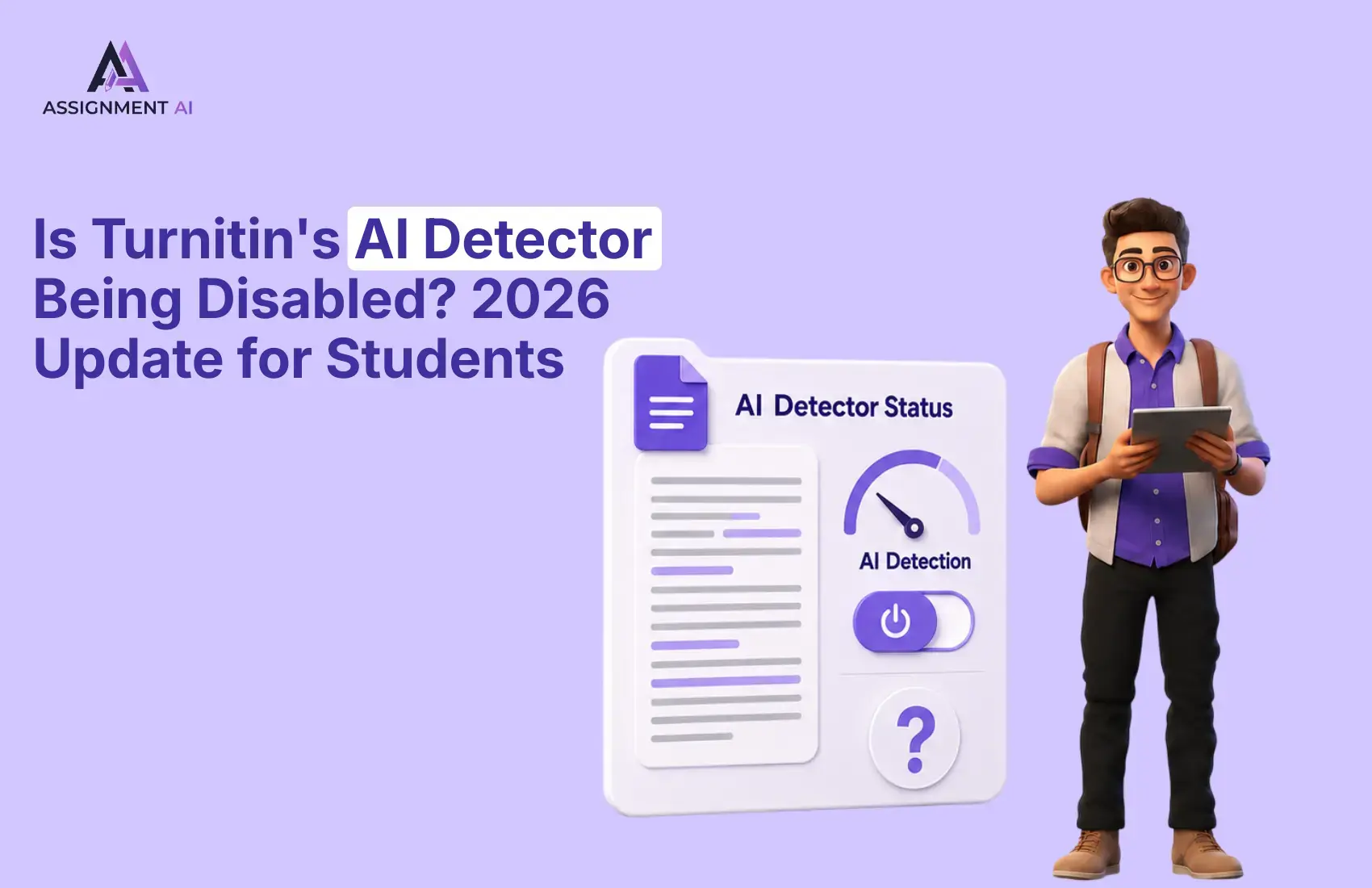
No, Turnitin has not turned off its AI detector worldwide. However, several universities have done so individually, leading to mixed messages
If you're using AI responsibly for research or drafting, tools like AssignmentGPT can help you brainstorm ideas, organize arguments, generate citations, and improve clarity without replacing your own academic work.
Here's what's actually happening: Turnitin continues to sell and use its AI writing detection software in 2026, and it is actively updating the model to counteract AI "humanizer" programs.
Meanwhile, individual universities are choosing to turn off the feature for their students, citing accuracy and fairness concerns.
This guide will explain which schools have turned off Turnitin AI writing detection, why they did it, what Turnitin's own accuracy reports say, and what it means for your next paper.
Is Turnitin Disabling Its AI Detector Company-Wide?
No, I believe Turnitin was not announced to retire AI detection as a company. In fact, they are continuing to develop the technology, including a February 2026 update focused on detecting AI-paraphrased and "humanized" texts with greater reliability.
Instead, the changes were made at the institutional level. For example, the University of Waterloo and Curtin University turned off Turnitin AI Detection features starting in late 2025 and early 2026, respectively. The stated reason was that scores for detecting AI-generated text were often too high to justify penalties based on mere suspicion.
So it is not that Turnitin is retiring the technology, but that some universities have chosen to disable it on a case-by-case basis.
Which Universities Have Disabled Turnitin's AI Detector?
No, they have not discontinued their efforts to detect AI-generated text as a company; on the contrary, they are planning to update the model again in Feb 2026 in an attempt to make it more reliable in detecting AI-paraphrased and "humanized" texts.
What happened is that some universities such as the University of Waterloo or Curtin University have decided to turn off their access to Turnitin's AI detection features at the end of 2025 and the beginning of 2026 because it was too prone to false positives and that assigning a probability score to students' essays was unfair.
It was the university administrations that turned off the detection features, not Turnitin.
Which Universities Have Disabled Turnitin's AI Detector?
As of March 2026, at least 12 major institutions had turned off Turnitin's AI writing detection feature, and more were reportedly reconsidering their policies.
Confirmed examples include:
| University | Status | Effective |
|---|---|---|
| University of Waterloo | Disabled | September 2025 |
| Curtin University (Australia) | Disabled across all campuses | January 1, 2026 |
| Yale University | Disabled | Reported by early 2026 |
| Johns Hopkins University | Disabled | Reported by early 2026 |
| Northwestern University | Disabled | Reported by early 2026 |
| Vanderbilt University | Disabled | Reported by early 2026 |
Turned out the reason the University of Waterloo shut down its AI writing detector is that during internal tests, the software showed that human-written texts were ''100% AI-generated,'' rendering it useless, according to this source - and this is one of the reasons that other educational institutions began to take action in September 2025, as well.
The reasoning behind Curtin's decision was more straightforward - according to this article, it was announced that starting from january 1st, 2026, the ability of Turnitin's AI writing detection will be turned off across all campuses and study periods, with the standard text-matching originality tools remaining available.
According to the text, this was done to maintain confidence and transparency in assessments while at the same time ensuring that practices remain fair and up-to-date, and that they continue to recommend alternative AI writing tools such as Grammarly and the Authorship feature. However, not all of the educational institutions that have turned off Turnitin's AI writing detection have made their statements public - hence, if yours is not on the list, it is advisable to look through course outlines or contact your faculty directly, as there may be differences in policy on a per-subject or per-professor basis.
Why Are Universities Turning Off Turnitin's AI Detector?
The reasoning is fairly consistent across schools:
False positive risk. A probability score misclassifying human writing as AI-generated can trigger an academic integrity case with real consequences.
Equity concerns. Detection error rates are documented to be higher for non-native English speakers.
No due-process substitute. Several administrators have argued a percentage score shouldn't replace a conversation between instructor and student.
Legal exposure. A wrongful AI accusation can escalate into appeals, grade disputes, or lawsuits.
Curtin's Academic Board cited reliability concerns about detection accuracy, equity issues tied to higher false positive rates for certain student populations, and a broader shift in focus for academic integrity review as the drivers behind its 2026 policy change.
How AssignmentGPT Helps Students Use AI Responsibly
As universities continue to refine their policies on AI-assisted writing, students need tools that support learning rather than encourage shortcuts. AssignmentGPT is designed to help throughout the writing process while keeping students in control of their work. Instead of generating a final paper to submit unchanged, it can assist with:
Brainstorming ideas and research topics
Creating well-structured outlines
Explaining difficult concepts in simple language
Generating accurate citations in multiple formats
Improving grammar, clarity, and readability
Refining drafts while preserving the student's original voice
When used responsibly, AssignmentGPT serves as a learning companion rather than a replacement for critical thinking. By combining AI assistance with your own research, revisions, and version history, you can produce stronger assignments while remaining aligned with your institution's academic integrity expectations.
How Accurate Is Turnitin's AI Detector in 2026?
This is the reality of the situation. Turnitin's advertised claims on the efficacy of their AI detection software do not match up to what independent researchers have found.
Turnitin itself has openly acknowledged that their technology can only accurately detect 98% of AI-generated content with less than 1% of false positives, if the paper contains 20% or more AI-generated text.
Below this threshold, the score is hidden behind an asterisk, as research shows that false positives are much more likely to appear, and the company does not want to inflate scores by using the incorrect percentage.
What other researchers have found: Many researchers have tested the accuracy of Turnitin's technology. According to a 2025-2026 study published in the International Journal for Educational Integrity, detection rates for AI content that had been edited by humans ranged from 60 to 85%
In summary, while Turnitin's technology is relatively effective against raw, unedited text, accuracy decreases drastically when the text is edited, paraphrased, or submitted through an anti-detection "humanizer" service. Similar decreases in detection rates were found across all studies for hybrid, human-AI written text.
Turnitin AI Detector vs. Independent Research: A Quick Comparison
| Metric | Turnitin's Claim | Independent Findings |
|---|---|---|
| Overall accuracy | ~98% | 61%–91% depending on study |
| False positive rate | Under 1% (above 20% threshold) | 4%–26% in various studies |
| Detection of edited/paraphrased AI text | Not separately disclosed | Drops to 60%–85% |
| Detection of hybrid human-AI writing | Not separately disclosed | Significantly less reliable |
| Bias against non-native English writers | Not acknowledged as a distinct metric | Documented in multiple studies as elevated risk |
What Happens If Your School Still Uses Turnitin AI Detection?
If your institution hasn't disabled the feature, a few practical points matter more than the marketing numbers:
The AI score is separate from your similarity score. A paper can show 0% plagiarism and still carry a high AI-writing percentage they measure different things entirely.
Scores under 20% are suppressed intentionally, so a low or asterisked result isn't necessarily "safe" it reflects a range where the company itself flags lower confidence.
Turnitin does not recalculate old reports automatically after a model update. If your instructor rechecks a paper post-update, the score can change.
A flag is not proof. Turnitin's own guidance states the score should not, by itself, be used to penalize a student; instructors are expected to review context, not just the number.
If you are accused, ask for the full report, collect drafts or version history as evidence of your own process, and request a direct conversation with your instructor before assuming the worst.
Students who work through drafts using these tools may find that assignmentGPT help services that retain thorough process documentation can be valuable resources, as the ability to demonstrate one's own process can often be overlooked in the chaos of an academic crisis.
How AssignmentGPT Helps Students Use AI Responsibly
As universities continue to develop policies on writing with AI assistance, students need tools to support their learning and writing process.
AssignmentGPT can help support you while writing, while still allowing you to maintain control over your writing. Rather than writing a paper to turn in, AssignmentGPT can help you with:
Brainstorming ideas and research topics
Creating well-structured outlines
Explaining difficult concepts in simple language
Generating accurate citations in multiple formats
Improving grammar, clarity, and readability
Refining drafts while preserving the student's original voice
When used responsibly, AssignmentGPT serves as a learning companion rather than a replacement for critical thinking. By combining AI assistance with your own research, revisions, and version history, you can produce stronger assignments while remaining aligned with your institution's academic integrity expectations.
Can Turnitin Detect ChatGPT and Other AI Tools?
Yes, on raw, unedited output. UCLA's Humanities Technology Lab found that detectors identified ChatGPT-generated text, in its most natural, unedited form, correctly 74 percent of the time; however, that stat drops dramatically when the text is edited, paraphrased, or mixed in with the writer's own words, which is precisely what most students would do with an AI tool if they were not using it as a research assistant
Turnitin's also been working on AI detection tools to counteract the rising tide of "AI bypassers" or "humanizers"
Third-party tools designed to make AI writing appear more human by editing or paraphrasing it, which it did in an updated release in August of 2025. They trained the model on the output of these "bypassers" so that it could more accurately identify text that had been run through them.
Conclusion
Turnitin's AI detection is not being discontinued entirely, but rather turned off selectively at the institutional level for those who believe the risk to be unworthy. It is up to individual schools to decide whether or not to adopt it.
As a student, your best course of action is to not rely on the score and ensure that you understand your institution's current policy on the tool, as well as treat it as a writing aid rather than a guarantee of success.
FAQs
1. Has Turnitin discontinued its AI detector company-wide?

2. Which universities have turned off Turnitin's AI detector?
3. Why are universities disabling AI detection?
4. How accurate is Turnitin's AI detector really?
5. Does Turnitin's AI score affect my plagiarism/similarity score?
6. Can Turnitin detect text from ChatGPT and other AI tools?
7. What should I do if my school still uses Turnitin's AI detector?
Digital Marketer | SEO
I’m Dipak Dangodara, the SEO Expert at AssignmentGPT AI. I manage and optimize the website’s search engine presence with a strong focus on organic growth, visibility, and performance. My work includes technical SEO, keyword research, on-page and off-page optimization, and tracking SEO performance to align with search engine best practices.
At AssignmentGPT AI, my goal is to build sustainable rankings, improve traffic quality, and ensure the platform delivers long-term value through effective SEO strategies.
Master AI with
AssignmentGPT!
Get exclusive access to insider AI stories, tips and tricks. Sign up to the newsletter and be in the know!
Transform Your Studies with the Power of AssignmentGPT
Empower your academic pursuits with tools to enhance your learning speed and optimize your productivity, enabling you to excel in your studies with greater ease.
Start Your Free Trial ➤Related Articles
Free vs Paid AI Homework Tools for Students in 2026
Compare free and paid AI homework tools in 2026 to find the best option for saving time, money, and improving study support.

10 AI Tools Every College Student Should Use in 2026
Discover 10 powerful AI tools every college student should use in 2026 to study smarter, save time, boost productivity, improve learning, & achieve better grades.
AssignmentGPT AI Citation Generator: Format Citations Fast
Create accurate APA, MLA, Chicago, and Harvard citations instantly with AssignmentGPT AI's free AI citation generator.
AI Homework Helpers: How They Are Changing Study Habits
AI homework helpers explain concepts step by step, helping students learn faster, study smarter, and build lasting confidence.

Best Flowchart Software Tools for Students and Developers
Compare the best flowchart tools for students, developers & engineers to create clear diagrams fast.

Best AI Diagram Tools for Engineers and Claude Code (2026)
Compare the best AI diagram tools for Claude Code workflows, engineering teams, and students in 2026.
Start your success story with Assignment GPT! 🌟 Let's soar! 🚀
Step into the future of writing with our AI-powered platform. Start your free trial today and revolutionize your productivity, saving over 20 hours weekly.
Try For FREE ➤