
AssignmentGPT Blogs

AI vs Traditional Studying: Which One Improves Grades in 2026?

Get an AI summary of this post on:





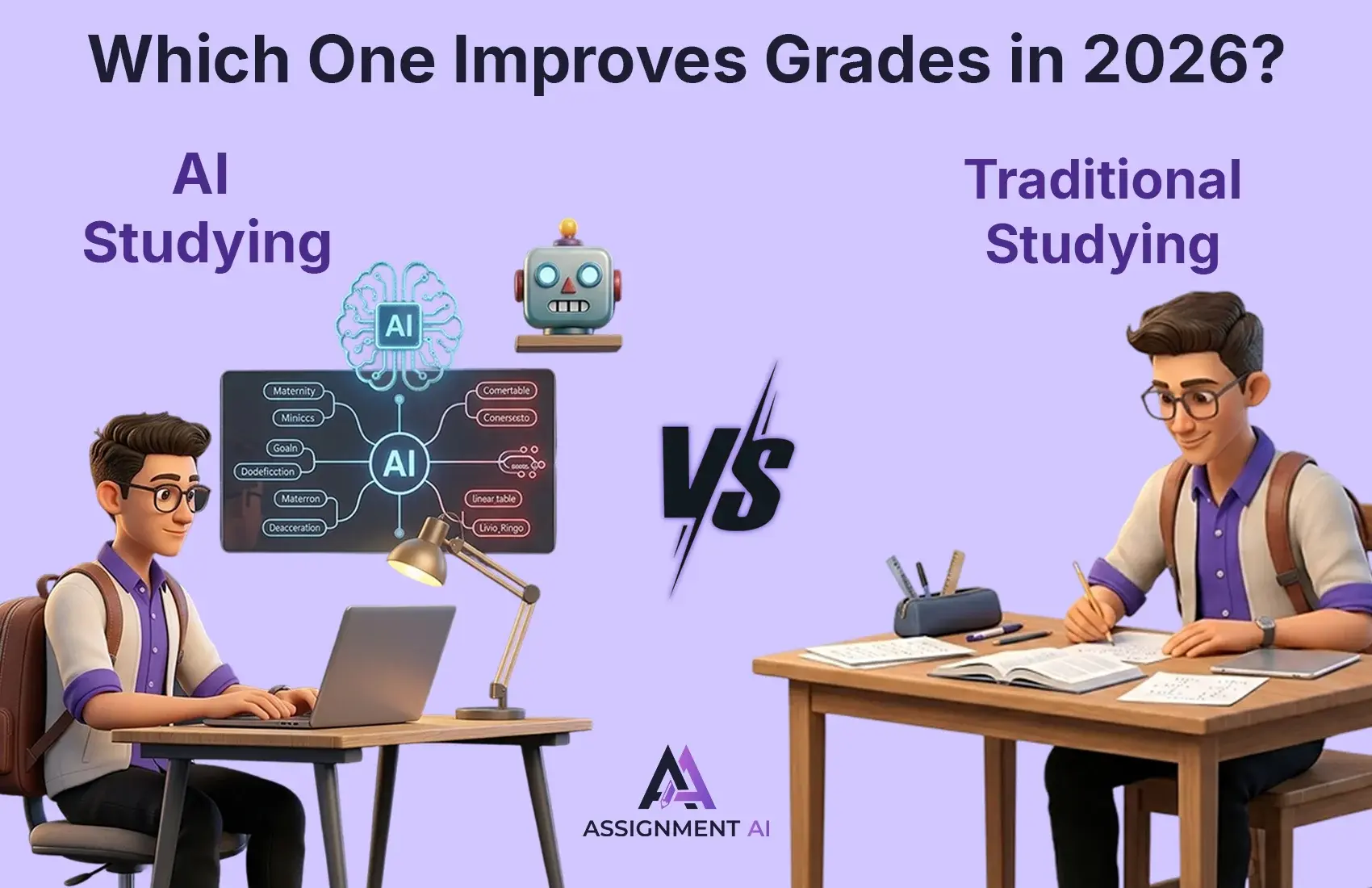
The time showed 11 PM when Rony, a 17-year-old student from a US university, studied for his upcoming board exam, which would take place in three weeks. His textbooks were open, and his notes were scattered, but his mind showed no signs of activity. The student needed four hours of study time, but he managed to remember only a small portion of what he learned.
Meera, who resided across the city, used an AI study tool to complete her schoolwork because it tested her knowledge and provided simple explanations while it identified her weak points. Meera reached a state of confidence by midnight. Rony experienced complete exhaustion.
The education system debate in 2026 revolves around AI and traditional studying methods, which people use to evaluate student performance. The research will begin after we establish three main parameters, which include effectiveness, personalization, and accessibility.
What Is Traditional Studying?
The traditional studying method serves as the standard educational system that people have followed since their early years. The study process requires students to read textbooks and create handwritten notes while they practice past exam papers and attend classroom lectures. For multiple generations, this educational approach has established the basic structure of learning.
Core features of traditional studying:
- Reading from physical or PDF textbooks
- Writing notes by hand or in notebooks
- Learning from teachers in classrooms or tuition centres
- Practicing from the previous year's question papers
- Group study sessions with friends
Students who engage in traditional studying methods develop better discipline and acquire deep reading skills while building relationships with their teachers. The system has one major drawback because it treats all students alike without considering their individual learning speeds and study methods.
What Is AI-Powered Studying?
Students who use AI-powered studying tools can access personalized educational content through ChatGPT, Google Gemini, Khan Academy's AI tutor, Khanmigo, and various other intelligent applications. In 2026, these tools have become significantly more advanced, capable of generating practice questions, simplifying hard concepts, detecting weak areas, and even predicting exam topics. To understand how this shift is reshaping classrooms, read more about the rise of AI in education.
Core features of AI-powered studying:
- Personalized quizzes based on your weak areas
- Instant doubt clearing, available 24/7
- Summarized notes from any textbook or chapter
- Smart revision schedules based on your performance
- Voice-based learning and interactive explanations
AI studying is not just about convenience. It is about efficiency. You study for less time but retain more information because the AI targets exactly what you need to learn.
Key Differences: AI vs Traditional Studying
| Parameter | Traditional Studying | AI-Powered Studying |
|---|---|---|
| Personalization | Same for all students | Customized per student |
| Availability | Limited to school hours | 24/7 access |
| Feedback Speed | Delayed (teacher checks) | Instant |
| Doubt Clearing | The next day in class | Within seconds |
| Cost | Books + tuition fees | Often free or low-cost |
| Engagement | Can be passive | Interactive and adaptive |
| Distraction Risk | Low | Higher (screen usage) |
| Deep Thinking | Encourages analysis | Depends on usage |
Which Method Actually Improves Grades?
The most critical inquiry of all is this. The genuine response to your question reveals that both techniques will help students achieve better academic results through distinct methods of improvement.
Studies conducted across schools in 2025 to 2026 show that:
- Students using AI tools scored 15 to 20 percent higher on average in objective-type exams.
- Students using traditional methods showed stronger performance in subjective and analytical questions.
- Students who combined both methods consistently outperformed those using only one approach.
The real winner is not AI or traditional studying alone. It is the smart combination of both. If you want to understand how this blend is changing the future of learning, check out how AI transforms education.
Step-by-Step: How to Use AI for Better Grades
Here is the actual working process, step by step, to incorporate AI into your study sessions and truly enhance your grades:
1. Identify Your Weak Subjects First
You should start using an AI tool such as ChatGPT or a dedicated application for your particular field of study. You should request a quiz from the system that tests you on your selected subject. The process identifies your weak points, which you need to study before you begin learning your strong areas.
2. Create a Personalized Study Timetable with AI
Request assistance from the AI by saying: "I have 3 weeks for my exams. Help me build a timetable for 5 subjects." The system will create a balanced schedule that prioritizes tasks based on your input because it uses specific data instead of random guessing. You can also look at tips on how to study effectively to build better habits alongside your AI timetable.
3. Use AI to Simplify Complex Concepts
When you encounter a difficult chapter, ask AI to explain it in simple language with an example. The method works best for science, mathematics, and economics because textbooks in those fields tend to create confusion.
4. Generate Practice Questions Instantly
Students should start their request for extra questions by approaching their teacher first, before using artificial intelligence to generate their questions. You can then ask AI: "Give me 10 MCQs on the topic of Photosynthesis, Class 10 CBSE level." The system allows you to practice specific skills that you need to develop within two seconds.
5. Review Mistakes and Ask for Explanations
You should analyze your incorrect answers after every quiz and mock test with AI. You should ask it to explain your mistakes and the correct reasoning behind them. The active revision method leads to better memory retention according to research studies. This is one of the core benefits of using homework AI that most students overlook.
6. Use Traditional Notes for Deep Revision
You need to write your own explanation of a concept after you have learned it through AI. Handwriting creates stronger memory traces than all other methods. Your handwriting shows what you learned from AI training.
7. Do Past Papers Without AI
Solving past year papers without any AI assistance sharpens exam-readiness. Students must treat the test conditions as authentic examination environments. This process develops time management skills while building writing confidence. For more on managing your time well, visit best time management skills for college students.
8. Use AI for Last-Minute Revision
In the final 48 hours before your exam, use AI to create short summary bullets of each topic. The quick revision method enables you to remember essential information more rapidly when you take the actual exam.
9. Track Your Progress Weekly
You need to track your progress through your AI tool's tracking system or by hand recording your quiz results. The next week, you should dedicate more time to studying a specific topic that shows no improvement in its score.
10. Stay Consistent, Not Just Smart
You need to follow daily study practices that cannot be replaced by any artificial intelligence tool. The first step towards your goal requires you to establish a specific time dedicated to studying, which you must follow consistently. Your academic performance improves when you maintain regular study habits because artificial intelligence functions as your helpful support system. Learning how to motivate yourself to study can make a real difference in keeping that consistency going.
Pros and Cons at a Glance
AI Studying: Pros
- Available 24/7, no waiting for a teacher
- Personalized to your specific weak areas
- Instant feedback and doubt clearing
- Makes difficult concepts simple and engaging
- Saves time through smart, targeted revision
AI Studying: Cons
- Screen time can lead to distraction
- May reduce deep thinking if overused
- Not always reliable for regional board-specific answers
- Requires internet access and a device
Traditional Studying: Pros
- Builds strong analytical and writing skills
- Encourages deep reading and retention
- Teacher-student interaction aids emotional learning
- Works best for subjective and essay-type exams
Traditional Studying: Cons
- One-size-fits-all approach with no personalization
- Slow feedback loop while waiting for teacher corrections
- Can become monotonous and disengaging
- Limited availability outside school hours
Conclusion
The debate between AI and traditional studying is not a competition. It is a conversation about how to study smarter in 2026. If Rony from our opening story had combined his textbooks with an AI study tool, he would not have sat staring blankly at midnight.
He would have studied with purpose, filled his specific gaps, and gone to bed confident. Today's academic environment favors students who study with effective methods rather than those who spend excessive time studying.
Traditional methods give you depth, discipline, and writing strength. AI provides you with fast results that adapt to your needs while delivering immediate understanding. Use both together, follow the step-by-step process above, and you will not just improve your grades. You will transform the way you learn forever.
The classroom has changed from its original form. Your study strategy should too. Begin your work today, maintain your effort consistently, and allow human wisdom together with artificial intelligence to guide you toward success. To get started with the right tools right away, check out the best AI tools for students.
FAQs
1. What is an AI study tool and how does it help students?

2. Is AI studying better than traditional studying for board exams?
3. Can AI study tools actually improve my grades?
4. Which AI study tool is best for school students in India?
5. How many hours should I study using AI tools each day?
6. Does using AI for studying reduce deep thinking skills?
7. What are the biggest disadvantages of AI studying?
8. How do I start using AI tools to study for exams?
9. Is AI studying free for school and college students?
10. What is the smartest way to combine AI and traditional studying?
Digital Marketer | SEO
I’m Dipak Dangodara, the SEO Expert at AssignmentGPT AI. I manage and optimize the website’s search engine presence with a strong focus on organic growth, visibility, and performance. My work includes technical SEO, keyword research, on-page and off-page optimization, and tracking SEO performance to align with search engine best practices.
At AssignmentGPT AI, my goal is to build sustainable rankings, improve traffic quality, and ensure the platform delivers long-term value through effective SEO strategies.
Master AI with
AssignmentGPT!
Get exclusive access to insider AI stories, tips and tricks. Sign up to the newsletter and be in the know!
Transform Your Studies with the Power of AssignmentGPT
Empower your academic pursuits with tools to enhance your learning speed and optimize your productivity, enabling you to excel in your studies with greater ease.
Start Your Free Trial ➤Related Articles
Free vs Paid AI Homework Tools for Students in 2026
Compare free and paid AI homework tools in 2026 to find the best option for saving time, money, and improving study support.

10 AI Tools Every College Student Should Use in 2026
Discover 10 powerful AI tools every college student should use in 2026 to study smarter, save time, boost productivity, improve learning, & achieve better grades.
AssignmentGPT AI Citation Generator: Format Citations Fast
Create accurate APA, MLA, Chicago, and Harvard citations instantly with AssignmentGPT AI's free AI citation generator.
Is Turnitin's AI Detector Disabled in 2026? Full Guide
Turnitin's AI detector isn't gone, but Waterloo, Curtin, Yale and others have disabled it. Here's why, and what it means.
AI Homework Helpers: How They Are Changing Study Habits
AI homework helpers explain concepts step by step, helping students learn faster, study smarter, and build lasting confidence.
Best Flowchart Software Tools for Students and Developers
Compare the best flowchart tools for students, developers & engineers to create clear diagrams fast.
Start your success story with Assignment GPT! 🌟 Let's soar! 🚀
Step into the future of writing with our AI-powered platform. Start your free trial today and revolutionize your productivity, saving over 20 hours weekly.
Try For FREE ➤