
AssignmentGPT Blogs

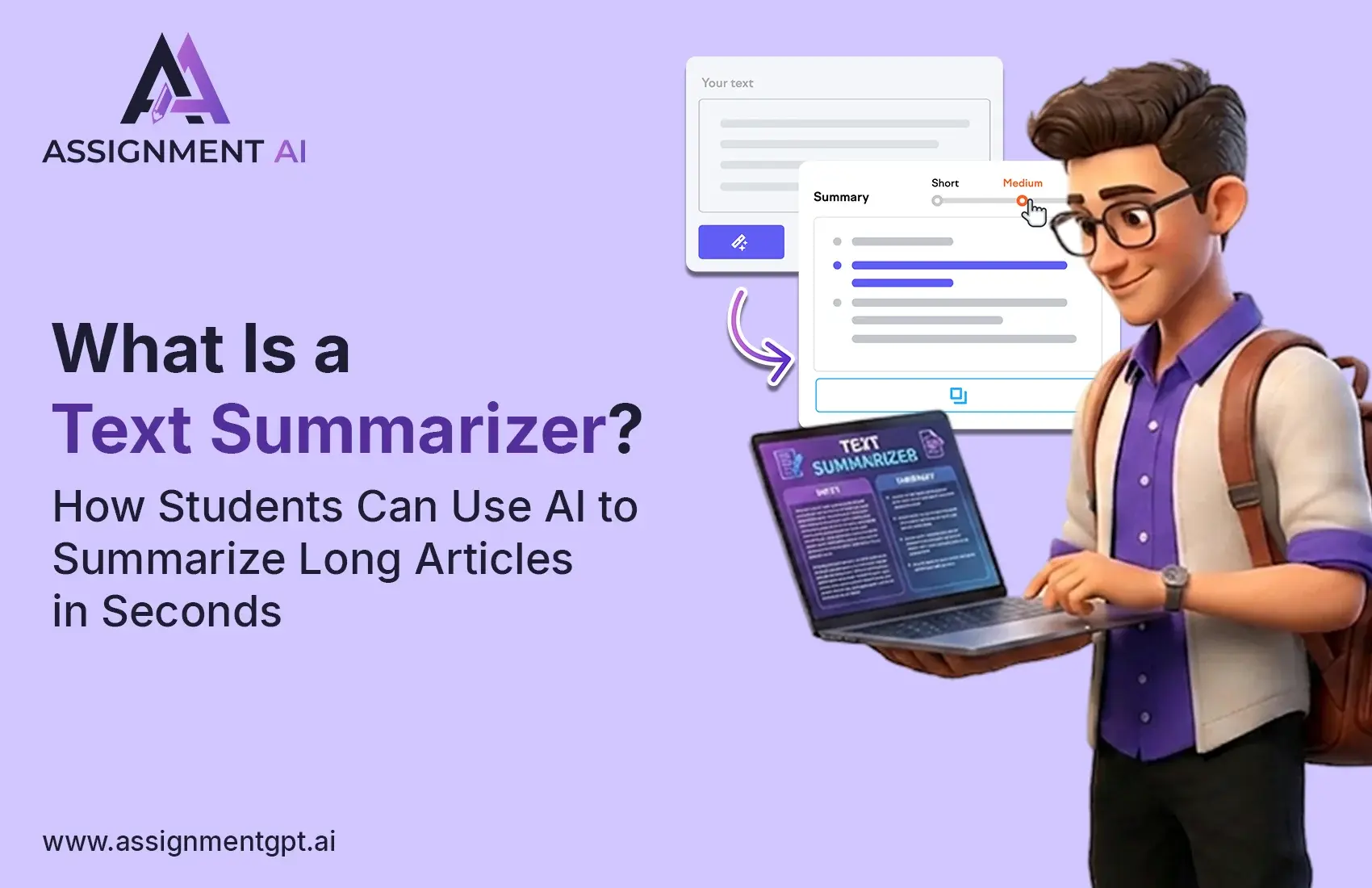
What Is a Text Summarizer? How Students Can Use AI to Summarize Long Articles

Get an AI summary of this post on:





The current time is 11:45 PM, and you must complete your assignment, which is scheduled for submission at dawn tomorrow. You currently have seven browser tabs active, one of which contains a three-thousand-word climate policy research article that you need to read. You have read the first two paragraphs of the first article three times, yet you still cannot remember any of its content.
You are not experiencing fatigue. You do not exhibit signs of inactivity. You are experiencing too much stress.
Every student understands this emotional state. The pile of reading never seems to shrink. The content includes textbooks, journal articles, news reports, and research papers, which students must read without any time limits. If you have ever wondered whether there is a smarter way to handle this, check out how AI tools are boosting student curiosity and productivity in real academic settings.
What would happen if you used a tool to analyze a large article and received an instant, accurate summary?
An AI text summarizer provides a function that delivers this exact result, which can serve as your essential study tool.
What Is a Text Summarizer?
The text summarizer functions as an artificial intelligence-powered tool that transforms extensive text materials into shorter summaries while retaining essential information.
Picture it as a highly intelligent companion who reads the complete article and proceeds to summarize its main points during coffee time. The presentation contains essential information without any unnecessary elements.
AI-powered summarizers go beyond simple copy-paste shortcuts. The system understands content at a high level and uses this knowledge to determine main ideas, which it presents through organized and understandable writing.
The services operate through online platforms, which users can access as a web application, browser extensions, or through existing applications on their devices.
Two Types of AI Summarization (Briefly Explained)
Not all text summarizers work the same way. There are two main approaches:
1. Extractive Summarization
This method selects essential sentences from the original text and assembles them into a complete set. It operates as a system that selects important text passages from the document. The words remain unchanged, yet the process selects different elements.
2. Abstractive Summarization
This method demonstrates greater complexity and generates more impressive results than the basic method. The AI system produces original content through its own word-based output, which it creates without using any particular sentence from the source material. Most modern AI summarization tools use this approach because the results feel more natural and easier to read.
Both methods have their place in educational settings. Students often find abstractive summarizers more helpful because they create summaries that feel natural rather than stitched together. If you want to understand the key difference between these approaches in academic work, reading about the difference between summarizing and paraphrasing is a great starting point.
How Do AI Text Summarizers Actually Work?
The content requires no computer science degree because it presents its fundamental explanation. The current AI summarization systems use Large Language Models as their foundational technology.
The models have learned language patterns through their training on vast text databases, which include books, articles, and websites. If you are curious about how these models function at a deeper level, the guide on what are large language models explains it in simple terms.
When you paste an article into a summarizer, the AI:
- Reads and processes the entire text
- Identifies the most important ideas and themes
- Filters out repetitive or less relevant content
- Rewrites the core information in a shorter, cleaner format
It all happens in a few seconds. What might take you 20 to 30 minutes to read and note-take is distilled into a digestible summary almost instantly.
Why Should Students Care? The Real Benefits
Students currently face multiple responsibilities because they must balance their academic requirements with their work commitments, social activities, and personal wellness needs. Your most valuable asset is your time because it represents your highest worth.
The following explanation shows how AI-powered text summarization tools assist students in their academic work.
Save Time Without Sacrificing Understanding: You can quickly understand the main points of a research paper because you need to spend only five minutes. The process allows you to use your time for deep content analysis instead of basic reading.
Improve Focus During Research: When you research a topic, you need to review multiple sources to locate the ones that contain relevant information. A text summarizer allows you to assess a source's importance before you decide to read the entire text. The system prevents users from spending 40 minutes on an article that proves to be entirely unrelated to their research needs. Pairing this habit with the right best AI tools for students can make your research sessions much more productive.
Better Exam Preparation: You need to complete your revisions for 10 chapters before your upcoming exam. You can create a quick revision sheet by pasting each chapter or your existing summary into an AI summarizer. The system functions as your custom study sheet, which you created yourself and is therefore completely legitimate.
Support for Non-Native English Speakers: People who speak English as their second language face greater challenges when dealing with extended academic texts. A summarizer can simplify complex language and sentence structures, making the content much more accessible.
Reduce Reading Anxiety: The task of reading a 5,000-word article becomes impossible to complete when you need to focus on its contents. The existence of a summary allows you to begin the process before you choose to investigate specific areas that require further examination. For students who struggle with this kind of pressure, learning about best stress management techniques for students alongside using AI tools can make a real difference.
Step-by-Step: How to Use an AI Text Summarizer
Ready to try it? Here is a simple process you can follow right now:
Step 1: Find a reliable AI summarizer: Some popular options include QuillBot, TLDR This, Scholarcy (great for academic papers), and even ChatGPT or Claude if you prefer conversational AI tools. You can also read a detailed QuillBot review to understand its features before you commit to using it.
Step 2: Copy your article or paste the URL: Most tools let you either paste the full text or drop in a link to a webpage. Some even let you upload a PDF.
Step 3: Choose your summary length: Many tools let you set how short or detailed you want the summary to be, whether a bullet-point overview, a short paragraph, or a longer condensed version.
Step 4: Read and review the summary: Do not just take the summary at face value. Skim through it and check: Does it capture the main argument? Are there any key details missing? Use the summary as a starting point, not a final answer.
Step 5: Go back to the original when needed: If a particular point in the summary catches your attention, dive back into the original article for more depth. The best approach is to use the summary to guide your reading, not replace it entirely.
Best Practices: Using AI Summarization the Smart Way
Your tool is only as good as the person using it. Here is how to use this powerful tool responsibly:
- Use it to understand better, not to avoid understanding. Summaries are a gateway into the content, not a shortcut around it.
- Always credit original sources in your assignments, even if you used a summarizer to read them faster.
- Double-check important facts. AI is not perfect. Sometimes it misses nuance or oversimplifies a point. For high-stakes assignments, verify key claims against the original.
- Combine with your own notes. After reading the summary, write down what you think the key takeaways are in your own words. This dramatically improves retention.
- Do not use it to generate your assignments. Summarizing for comprehension equals smart studying. Pasting a summary as your own work equals academic dishonesty. There is a clear difference. If you are unsure about where the line is, reading about is using AI cheating and tips for ethical use can help you stay on the right side.
Limitations: What AI Summarizers Cannot Do
Text summarization tools have limitations that apply to all existing tools. The following points need to be monitored:
The system fails to understand context fully: Academic arguments often rely on subtle reasoning. The summarizer may capture the spoken content but fail to show its important relevance.
The system cannot process specialized technical information accurately: The AI system will simplify things when you read a document that contains mathematical formulas, legal terms, or medical words, but this can create problems because the system may produce incorrect results.
Critical thinking remains essential for human beings: Your student duty requires you to assess an article, understand its content, question its arguments, and use its information. The summarizer cannot complete that work for you. Learning tips on how to study effectively alongside using AI tools will always give you better results.
The output quality depends on the input quality: The summary of an original article becomes disorganized when the article contains poor writing and disorganized content.
AI summarization should function as one of your available tools instead of becoming your primary resource.
Real-Life Use Cases: Where This Actually Helps
Still wondering how this fits into your actual student life? Here are a few everyday scenarios:
Writing a Research Paper: You need to review 15 sources. The summarizer tool helps you understand each source immediately. You should choose the five sources that are most useful for your research. Combining this with how to write an essay using AI tools gives you a full workflow from research to writing.
Preparing for Seminars or Discussions: Your professor assigned three readings for tomorrow's class. Use a summarizer to get the core arguments of each, so you can contribute meaningfully to the discussion, even if you did not have time to read every word.
Exam Revision: You need to create brief summaries that present essential information from your lecture notes and textbook chapters. The summaries must be reviewed multiple times throughout the days leading up to your exam. Spaced repetition plus summarization creates a strong learning method. You can also look into revolutionizing learning and study habits with homework AI to build an even stronger revision strategy.
Keeping Up With Current Events: Many courses require you to follow news related to your subject. Use a text summarizer on long news articles to stay informed without spending your whole day reading.
Group Projects: The reading material should be divided among all group members. Each group member must use a summarizer to create summaries of essential content. The group will use the summaries to create common study materials. The system works well because it enables people to work together while achieving their goals.
Conclusion
The volume of information students are expected to process today is genuinely overwhelming, and the pressure that comes with it is very real. However, alongside this challenge, there are also powerful tools available to make things easier.
The purpose of an AI text summarizer is not to obtain shortcuts but to enable efficient work methods. Students can grasp essential information from complex materials within minutes instead of spending hours on their understanding, because they can use the materials to study at their own pace.
FAQs
1. What is a text summarizer and how does it work?

2. Can I use AI to summarize a long article quickly?
3. Is an AI text summarizer good for students?
4. What is the difference between extractive and abstractive summarization?
5. Are AI summarizers accurate enough to use for schoolwork?
6. Does using a text summarizer count as cheating?
7. Which is the best AI text summarizer for students?
8. Can AI summarize a PDF or uploaded document?
9. How long should a good AI-generated summary be?
10. Can non-English speakers benefit from using a text summarizer?
Master AI with
AssignmentGPT!
Get exclusive access to insider AI stories, tips and tricks. Sign up to the newsletter and be in the know!

Transform Your Studies with the Power of AssignmentGPT
Empower your academic pursuits with tools to enhance your learning speed and optimize your productivity, enabling you to excel in your studies with greater ease.
Start Your Free Trial ➤Related Articles
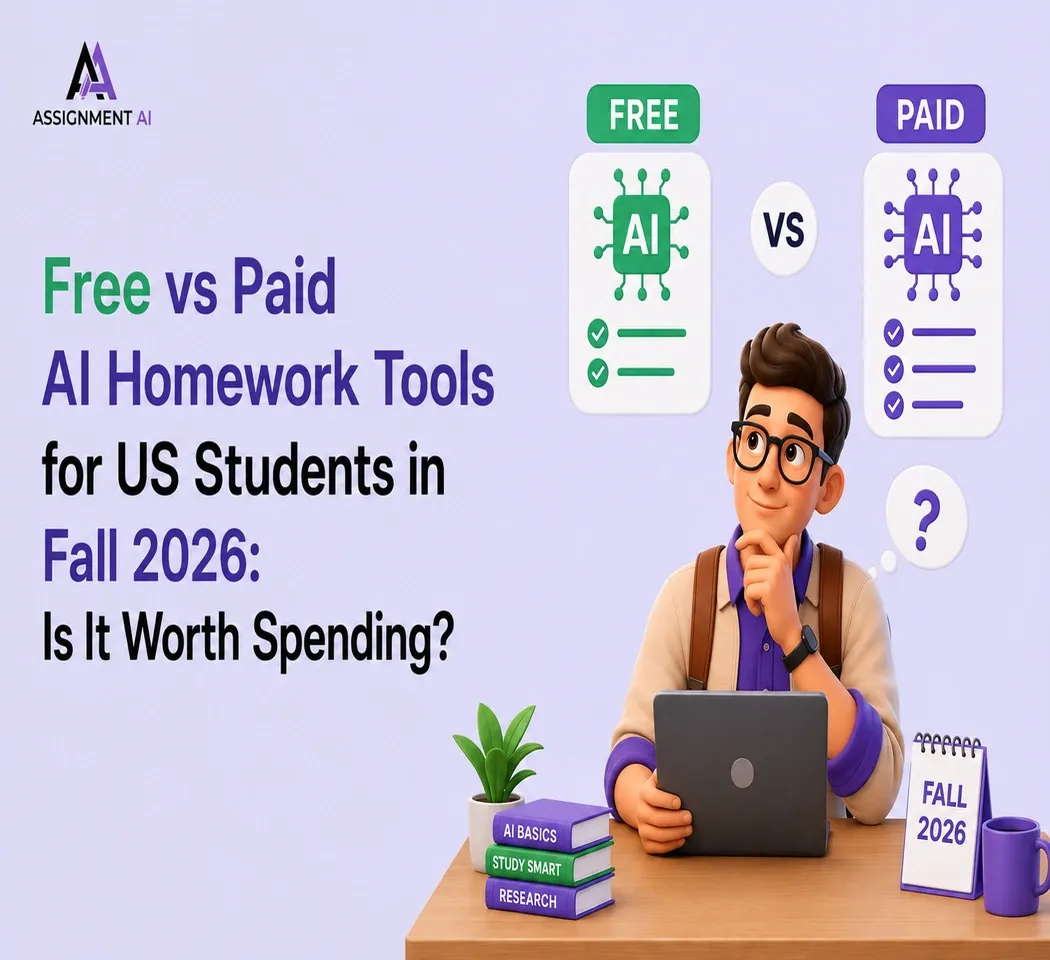
Free vs Paid AI Homework Tools for Students in 2026
Compare free and paid AI homework tools in 2026 to find the best option for saving time, money, and improving study support.

10 AI Tools Every College Student Should Use in 2026
Discover 10 powerful AI tools every college student should use in 2026 to study smarter, save time, boost productivity, improve learning, & achieve better grades.
AssignmentGPT AI Citation Generator: Format Citations Fast
Create accurate APA, MLA, Chicago, and Harvard citations instantly with AssignmentGPT AI's free AI citation generator.
Is Turnitin's AI Detector Disabled in 2026? Full Guide
Turnitin's AI detector isn't gone, but Waterloo, Curtin, Yale and others have disabled it. Here's why, and what it means.
AI Homework Helpers: How They Are Changing Study Habits
AI homework helpers explain concepts step by step, helping students learn faster, study smarter, and build lasting confidence.
Best Flowchart Software Tools for Students and Developers
Compare the best flowchart tools for students, developers & engineers to create clear diagrams fast.
Start your success story with Assignment GPT! 🌟 Let's soar! 🚀
Step into the future of writing with our AI-powered platform. Start your free trial today and revolutionize your productivity, saving over 20 hours weekly.
Try For FREE ➤