
AssignmentGPT Blogs

Is Claude Opus 4.7 Writing Detectable by AI Tools?

Get an AI summary of this post on:





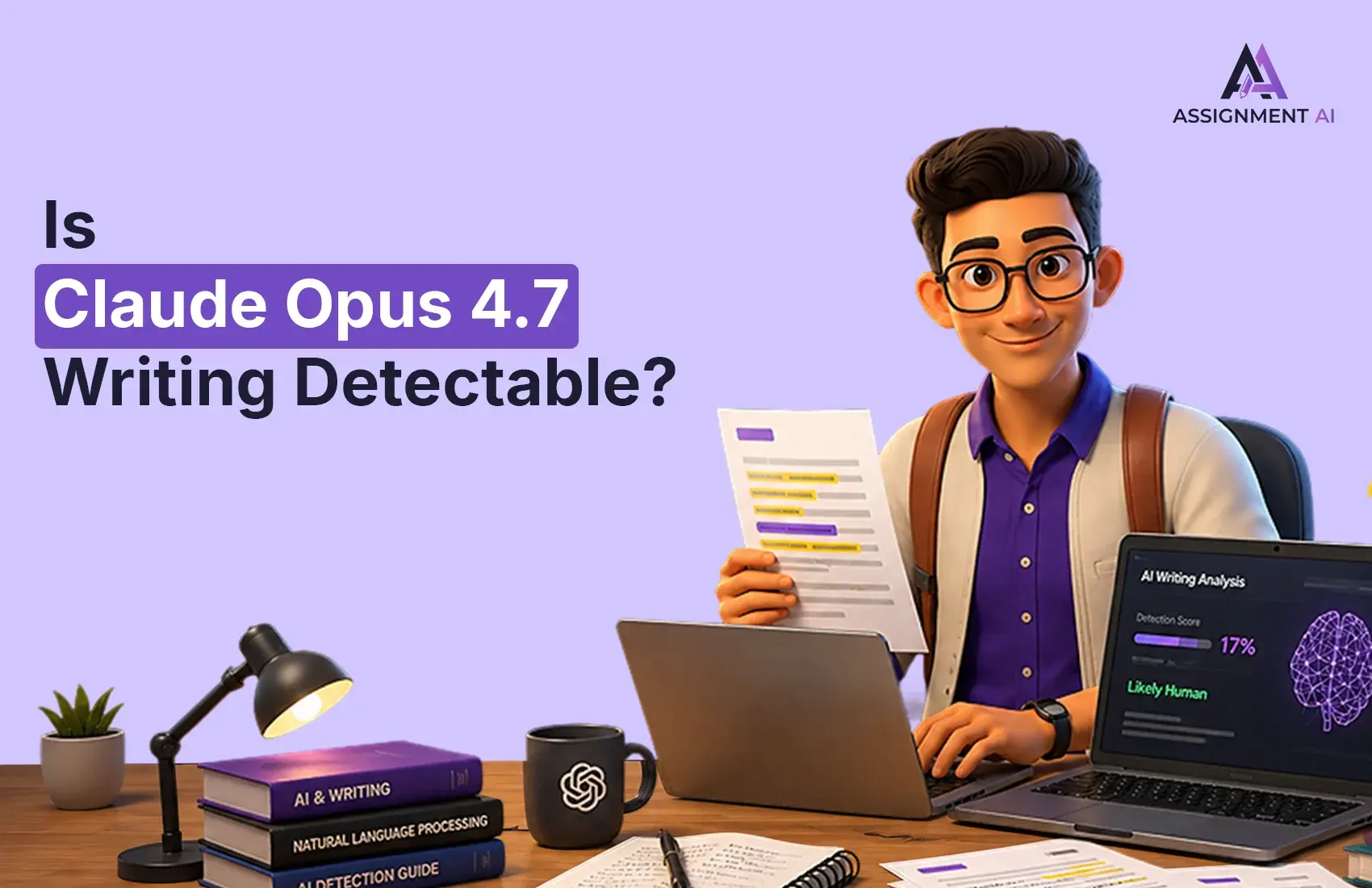
AI detection for "Claude Opus" writing is a topic that really confuses a lot of content creators, students, and even marketers. Like it's one of those things where everyone asks the same question, but nobody agrees on the answer.
And since Claude Opus 4.7 is now one of the most widely used AI writing tools, people keep wondering if what it generates can actually be caught by detection software, which honestly feels more important than ever. If you want a broader picture of how this whole process works, this guide on how AI content detection works is worth reading before diving in.
So this article sort of walks through how AI detectors work in general, what makes Claude's writing style feel a bit different, and what you can realistically expect when you run the output through common tools such as GPTZero, Turnitin, or Originality.ai. None of this is magic, though, and the results are not always as straightforward as people hope.
What Is Claude Opus and Why Is It Popular?
Claude Opus is basically Anthropic's most advanced AI language model. It's made for complex reasoning, more nuanced prose, and high-accuracy type jobs. Claude Opus 4.7 keeps those strengths but also adds extended thinking plus tool use, so it becomes kind of a preferred option for professionals, researchers, and content crews.
What Makes Claude Opus Different
Claude is kind of built on a Constitutional AI framework, and that training approach makes the output feel more conversational, less rigid, compared with other models. So the stuff it writes usually sounds more natural, which is great, but also a bit tricky, especially when you think about AI detection. Sometimes it seems easier to pass for human writing, but the flip side is that there are also more challenges.
If you're curious about what Claude AI actually is under the hood, this overview of Claude AI breaks it down clearly.
Key traits of Claude Opus writing:
- Avoids repetitive transition phrases like "moreover" or "in conclusion"
- Tends toward longer, more structured sentence patterns
- Uses impersonal constructions like "one might argue" instead of "I think"
- Produces parallel clause structures with high consistency
Common Uses of Claude Opus
- Long-form blog writing and content marketing
- Academic research summarization
- Customer support and email drafting
- Code generation and technical documentation
- Financial and data report writing
How AI Detection Tools Identify AI-Generated Content
AI detectors don't read the content like a human would, not really. They look at statistical patterns in the text, trying to judge how "machine-like" the writing feels. Like it's less about meaning, more about those tiny regularities, and odd phrasing that kind of thing.
Perplexity and Predictability
Perplexity kinda measures how much the next word in a sentence feels "guessable". If the perplexity is low, it usually means the text is sticking to very normal, expected word patterns, which many people take as a hint of AI-ish generation. A human tends to lean into a few odd turns of phrase, the kind that makes the perplexity number climb a bit.
Say you have "The hero decided to..." An AI might finish that with something like "save the day", you know, the very standard thing. But a human could go with "call it quits" instead, and that switch is less expected, so the model gets more uncertain, raising perplexity.
To understand how perplexity and burstiness actually interact in writing, this deep dive into perplexity and burstiness in writing explains it well.
Claude Opus, trained around Constitutional AI principles, also tends to dodge a bunch of repetitive transition words that often smooth things out in models like GPT. So in practice, its output can end up with a somewhat higher perplexity score than some other tools.
Burstiness and Sentence Variation
Burstiness is basically the degree to which sentence length and the overall way sentences are built wiggle around inside a piece of writing. With real human text, people often throw in short punchy bits, then switch into longer, more tangled sentences, so the rhythm feels kind of uneven, not "steady" all the time.
AI writing, however, often comes out with sentences that are pretty consistent in length and tone. Those detectors tend to notice that smoothness, treating it like a kind of tell for machine-made text.
Claude Opus has been mentioned as leaning toward longer average sentence lengths, plus parallel clause structures. Those choices, while they can sound polished and clever, may still get noticed by modern detectors after 2024 or so, depending on the setup.
Linguistic Patterns Used by Detectors
Beyond perplexity and burstiness, modern detection tools use several additional signals:
- Style fingerprinting: Matching text against a database of known AI outputs
- First-person avoidance: Claude tends to avoid "I" even in personal writing, which is statistically detectable
- Phrase-level probability scoring: Each sentence is scored for how likely it is to have come from a language model
- Structural pattern recognition: Consistent heading use, parallel lists, and clause repetition are flagged
Tools like GPTZero, Originality.ai, and Turnitin have all updated their models to start flagging Claude-style writing patterns, basically as a kind of signature or thing.
Can Claude Opus Writing Be Detected?
Sure, you can say that Claude Opus writing is detectable, but not always in a consistent way. When people ran tests with Originality.ai on Claude 4 Opus, it seemed like the model often produced output that could be detected whether the text was basically scratch-written, rewritten, or more humanized.
In another round, Turnitin testing done by independent researchers showed something like about 70% of the Claude Opus 4 samples got flagged, and the remaining 30% slipped through. A big reason for that was pretty simple at the time: Turnitin's system hadn't been fully trained on Claude Opus 4's exact kind of phrasing style yet, so the detection wasn't fully tuned.
Key factors that affect detectability:
- Prompt type: Generic prompts produce more detectable output
- Post-editing: Human editing after generation significantly lowers detection rates
- Content length: Very short texts under 100 words are harder for detectors to evaluate accurately
- Detector recency: Tools continuously update their training data. Text that passed detection one month may fail the next
The honest answer is that no AI model writes in a permanently undetectable way. Claude Opus is harder to catch than older models, but advanced tools will flag it in most standard testing scenarios. For a closer look at the best AI content detection tools available right now, that roundup covers the major options in detail.
Claude Opus vs GPT: Which Is Harder to Detect?
Both models are detectable, but they present different challenges for detection tools.
| Factor | Claude Opus | GPT-4 / GPT-5 |
|---|---|---|
| Transition phrase use | Low (harder to detect) | Higher (easier to flag) |
| Sentence length uniformity | Moderate to high | Moderate |
| First-person avoidance | Strong pattern | Less consistent |
| Perplexity score | Naturally higher | Generally lower |
| Burstiness | Moderate | Moderate to low |
Claude's Constitutional AI training tends to make it dodge those really formulaic turns of phrase that GPT-style models can crank out. Because of that, you sometimes see it doing better on perplexity-based evaluations, as it feels more "in the flow" and less patterned. For a head-to-head breakdown, this Claude vs ChatGPT comparison covers the key differences across multiple use cases.
But of course, Claude isn't some perfect ghost. It has its own set of recognizable rhythms, like parallel clauses here and there, plus those kinds of impersonal constructions, and modern detectors have been tuned specifically to catch that sort of thing.
So neither one is going to be reliably unflagged. Picking between them purely for detection evasion is honestly not a good plan.
Why AI Detectors Often Produce False Positives
A false positive happens when a detector flags human-written content as AI-generated. This is a serious and growing problem.
Reasons false positives occur:
- Clean, polished writing is often mistaken for AI output because it lacks the "noise" of typical human writing
- Short texts do not give detectors enough data to measure patterns accurately
- Technical or formal writing follows predictable structures that overlap with AI patterns
- Non-native English writers often produce lower burstiness, which detectors interpret as machine-like
Detectors like GPTZero have publicly acknowledged that their accuracy is not perfect and recommend combining tool results with human judgment. Relying solely on an AI detector to make decisions about authorship is unreliable and potentially unfair. You can read a detailed GPTZero AI detector review to understand exactly where its strengths and blind spots tend to fall.
Best Practices for Using Claude Content Responsibly
Using Claude Opus in your workflow is not inherently problematic. The key is to use it transparently and edit the output thoughtfully.
For Content Creators
- Always review and edit AI-generated content before publishing
- Add personal experience, opinions, and examples that the AI cannot replicate
- Vary sentence lengths manually to increase burstiness
- Disclose AI use where required by your platform or institution
For Researchers and Students
- Follow your institution's specific AI use policy
- Use AI for brainstorming and structure, not as a final submission
- Add your own analysis and sourced evidence to any AI-generated draft
For students especially, understanding how to avoid AI detection while staying within ethical boundaries is a balancing act worth learning properly.
Conclusion
Yeah, this whole Claude Opus style AI detection thing is still kind of evolving. You know, like there's no real permanent fix, not on either side. Claude Opus 4.7 puts out text that sounds really natural, actually some of the most natural-sounding AI writing you can find lately, but then again, modern detectors have caught on to the kinds of patterns it tends to use. So the most practical route is to take whatever it generates, then adjust it with real human input, stick with the transparency guidelines and all that, and don't end up depending too much on one single AI tool or one detection system, even if it feels convenient at first.
FAQs
1. Can Claude Opus 4.7 writing be detected by AI tools?

2. How do AI detection tools identify Claude Opus writing?
3. What is perplexity and why does it matter in AI detection?
4. Is Claude Opus harder to detect than ChatGPT?
5. What is burstiness and how does it affect AI writing detection?
6. Can I make Claude Opus writing undetectable?
7. Does Turnitin detect Claude Opus 4.7 content?
8. Why do AI detectors sometimes flag human writing as AI-generated?
9. What are the best practices for using Claude Opus content responsibly?
10. Is using Claude Opus for writing considered cheating?
Digital Marketer | SEO
I’m Dipak Dangodara, the SEO Expert at AssignmentGPT AI. I manage and optimize the website’s search engine presence with a strong focus on organic growth, visibility, and performance. My work includes technical SEO, keyword research, on-page and off-page optimization, and tracking SEO performance to align with search engine best practices.
At AssignmentGPT AI, my goal is to build sustainable rankings, improve traffic quality, and ensure the platform delivers long-term value through effective SEO strategies.
Master AI with
AssignmentGPT!
Get exclusive access to insider AI stories, tips and tricks. Sign up to the newsletter and be in the know!

Transform Your Studies with the Power of AssignmentGPT
Empower your academic pursuits with tools to enhance your learning speed and optimize your productivity, enabling you to excel in your studies with greater ease.
Start Your Free Trial ➤Related Articles

Free vs Paid AI Homework Tools for Students in 2026
Compare free and paid AI homework tools in 2026 to find the best option for saving time, money, and improving study support.

10 AI Tools Every College Student Should Use in 2026
Discover 10 powerful AI tools every college student should use in 2026 to study smarter, save time, boost productivity, improve learning, & achieve better grades.
AssignmentGPT AI Citation Generator: Format Citations Fast
Create accurate APA, MLA, Chicago, and Harvard citations instantly with AssignmentGPT AI's free AI citation generator.
Is Turnitin's AI Detector Disabled in 2026? Full Guide
Turnitin's AI detector isn't gone, but Waterloo, Curtin, Yale and others have disabled it. Here's why, and what it means.

AI Homework Helpers: How They Are Changing Study Habits
AI homework helpers explain concepts step by step, helping students learn faster, study smarter, and build lasting confidence.

Best Flowchart Software Tools for Students and Developers
Compare the best flowchart tools for students, developers & engineers to create clear diagrams fast.
Start your success story with Assignment GPT! 🌟 Let's soar! 🚀
Step into the future of writing with our AI-powered platform. Start your free trial today and revolutionize your productivity, saving over 20 hours weekly.
Try For FREE ➤