
AssignmentGPT Blogs

AI in Education: Opportunities and Challenges for Educators

Get an AI summary of this post on:





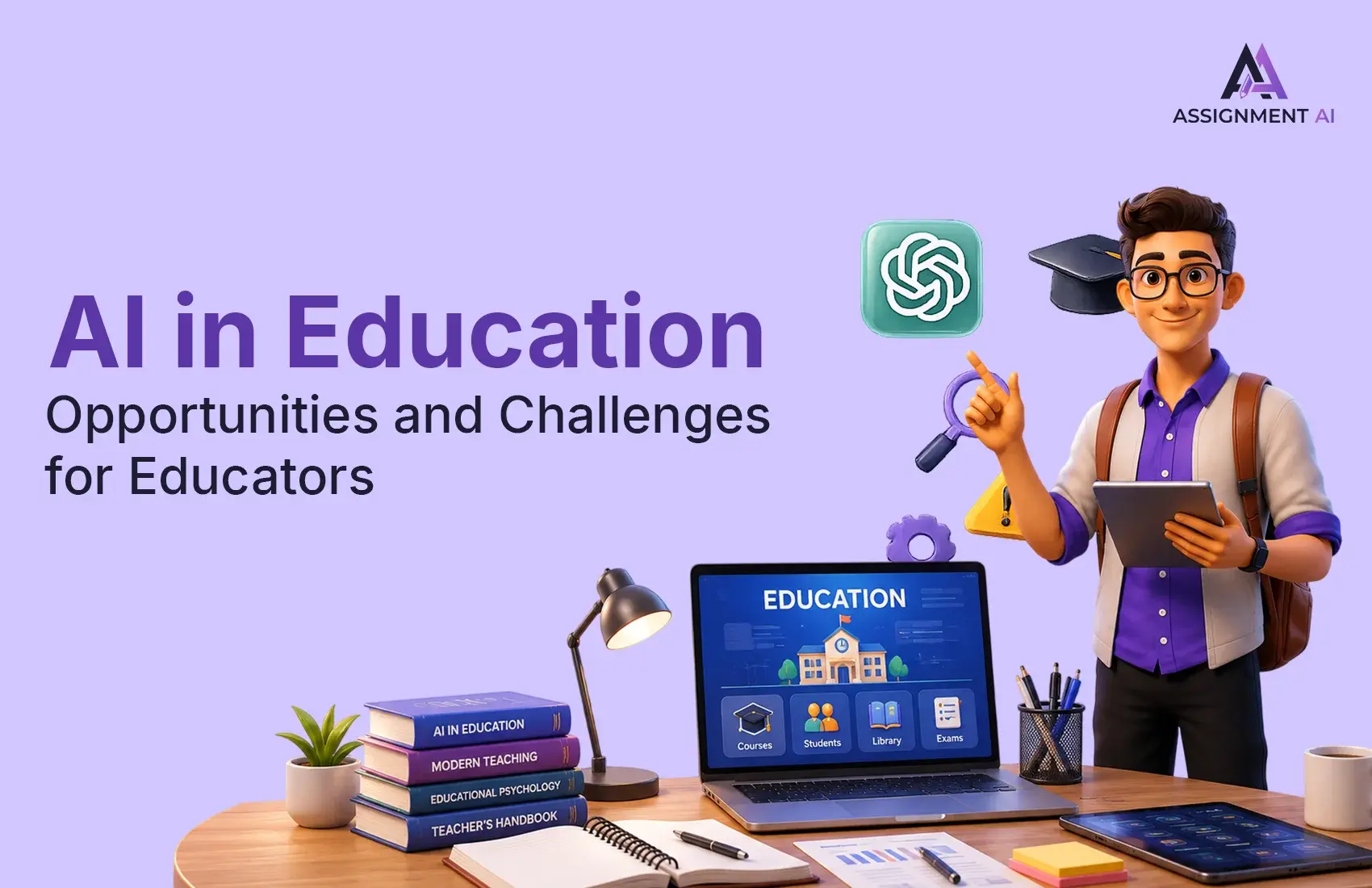
The educational field has already experienced the effects of AI detection tools, which teachers, professors, and administrators face together with instructional designers. Students submit suspiciously polished essays. Colleagues debate academic integrity. Administrators inquire about your school institution's existing "AI policy".
The shift is happening fast. The professionals who understand AI educational applications will create future advancements because they know how the technology operates.
The article presents AI academic opportunities together with the actual difficulties you will encounter and shows how educators and students use AssignmentGPT AI to explore this emerging field while maintaining their authentic learning experience.
Why This Topic Matters More Than You Think
The present situation of educational institutions shows that artificial intelligence technology has become a current practice. A 2024 survey found that over 60% of college students had used an AI tool for at least one academic task. Institutions currently lack any official guidelines for their AI technology implementation.
The problems arise at this point because institutions lack the necessary resources to handle current situations. The same location that creates issues for organizations also provides spaces for discovering possibilities.
For academic professionals, the stakes are high:
- Curriculum design needs to account for AI-assisted learning
- Assessment methods built for a pre-AI world may no longer hold up
- Student outcomes depend on whether AI becomes a crutch or a catalyst
- Institutional trust hinges on handling AI adoption with clear, fair policies
Let's start with what's actually working.
The Real Opportunities AI Brings to Education
1. Personalized Learning at Scale
The standard classroom environment faces its primary challenge between one instructor and thirty students who possess different learning capabilities. The adaptive learning solution from AI delivers tailored educational content that matches the needs of individual students. Adaptive learning platforms can identify where a student is struggling, say, quadratic equations or essay structure, and serve targeted exercises before the confusion compounds.
The solution does not function as a teaching substitute. The solution operates as a teaching assistant that maintains a continuous working capacity while monitoring all students.
What this looks like in practice:
- A struggling student gets more foundational practice automatically
- An advanced learner moves ahead without waiting for the class
- The teacher gets a dashboard showing who needs direct attention
2. Smarter Feedback, Faster
The process of teaching requires extensive time dedication because teachers need to provide effective feedback. The AI establishes a foundation for work because it can identify structural essay problems and show which arguments contain logical flaws and which parts contain grammatical errors.
The AssignmentGPT AI tool functions as a research assistant for this academic work. The student platform enables draft assessment, which helps students improve their work before submitting it to teachers. Time savings for teachers result from this process, which leads to improved classroom discussions.
3. Research Assistance That Actually Works
Literature reviews used to take weeks. AI tools can complete the task of analyzing multiple studies which produces essential results within a few hours.
The process of writing a thesis or research paper becomes easier for students because of this development. The system helps users evaluate information while they need to synthesize material and present their arguments. The system eliminates repetitive tasks, which causes students to experience burnout before reaching their most enjoyable activities.
4. Accessibility and Inclusion
AI is quietly becoming one of the most powerful accessibility tools in education:
- Text-to-speech and speech-to-text for students with dyslexia or motor impairments
- Real-time translation for non-native English speakers
- Simplified explanations for students who need different levels of abstraction
This democratization of quality educational support is one of AI's most underappreciated benefits.
The Challenges Academic Professionals Actually Face
The educational system gains benefits from artificial intelligence technology. The system encounters multiple challenges that require complete examination because their existence cannot be ignored.
Challenge 1: Academic Integrity in the Age of AI
People are discussing this particular thing. When a student submits an AI-generated essay, is it plagiarism? Cheating? Or a new form of research?
Institutional contexts determine the answer because current institutions lack complete context guidelines.
The problem exists because students can access AI technology. The existing rules create problems because they are not consistent, while detection technology fails to identify violations, and existing punishment systems were created to address different types of violations.
What's actually helping:
- Shifting toward process-based assessments (show your work, submit drafts)
- Oral defenses of written work
- Assignments that require personal reflection, local knowledge, or lived experience
- Clear, specific policies that distinguish using AI to brainstorm from submitting AI output as your own
Challenge 2: The Skill Gap Among Educators
Teachers face challenges when they attempt to implement artificial intelligence in their work because they lack knowledge about the initial steps for implementation. Tools have undergone rapid evolution, yet professional development for educators at most institutions has failed to keep up with these advancements.
A professor who learned to teach in 2005 may have never needed to think about prompt engineering, AI literacy, or what "hallucination" means in the context of an AI research tool.
The statement does not express disapproval. Institutions need to establish proper employee development programs which should include more than just workplace regulations.
Challenge 3: Over-Reliance and Shallow Learning
The fundamental issue that exists within educational artificial intelligence systems stems from their dual nature which enables learners to advance their studies while also providing a pathway for complete academic dishonesty. When students use AI tools to create all their drafts, summarize all reading materials, and solve all practice problems, they will submit their work on time, yet they will not acquire any knowledge. The crutch problem describes this situation.
Educators create educational programs that require students to demonstrate their use of artificial intelligence for educational purposes through well-organized frameworks instead of prohibiting its usage. The assignment "Use AI to generate three counterarguments to your thesis, then pick the strongest one and refute it" requires students to demonstrate different skills than "write a five-paragraph essay."
Challenge 4: Data Privacy and Ethical Concerns
When students use AI tools, their data gets processed through unknown channels. The ownership of conversation logs belongs to unknown entities. A company can use student essays as training material for its model development process.
The questions are legitimate because educational institutions have valid reasons to proceed with caution. Educational institutions should select AI platforms with transparent data practices while they teach students about digital literacy skills.
Step-by-Step: How Academic Professionals Can Integrate AI Thoughtfully
Here's a practical framework, not a theoretical one.
Step 1: Audit Your Current Assessments
The student needs to review their current tasks because they must evaluate which assignments allow complete AI execution to determine the student's actual understanding. The first assessment needs redesign because it currently fails to measure the intended learning objectives.
Step 2: Define What AI Use Is Acceptable
Don't leave students guessing. Create a simple, specific AI use policy for your course:
- Can students use AI for brainstorming? Yes/No
- Can they use it to draft? Yes/No, with conditions
- Do they need to disclose AI use? How?
Ambiguity breeds anxiety and dishonesty. Clarity builds trust.
Step 3: Build AI Literacy Into the Curriculum
The educational process should include instruction about AI systems, which requires students to learn both their operational functions and their practical applications. Students who learn that AI systems can produce inaccurate results can evaluate results better because they understand this capability of AI systems.
People who possess this ability can research any source to verify and combine multiple pieces of information.
Step 4: Use AI Tools Yourself
You need firsthand experience to help students complete their assignments through AI-based systems. Spend two hours testing AssignmentGPT AI tools. You need to learn their strengths and weaknesses and their ability to produce different results through various prompts.
The experience will help you create assignments and teach students proper usage methods.
Step 5: Evaluate Outcomes, Not Just Outputs
Your assessment should include weight for your demonstration of understanding through your involvement in discussions and presentations, your performance during in-class problem-solving, and your process of making revisions while writing reflection notes.
If a student can explain their work and engage with questions about it, they have learned something regardless of what tools they used along the way.
Tools Worth Knowing About
| Tool | Best For | AI-Powered? |
|---|---|---|
| AssignmentGPT AI | Writing assistance, research support, assignment help | Yes |
| Turnitin (AI Detection Mode) | Detecting AI-generated content | Yes |
| Grammarly | Grammar and clarity feedback | Partially |
| Elicit | Research literature review | Yes |
| Khanmigo (Khan Academy) | Personalized tutoring | Yes |
| Notion AI | Notes, planning, summaries | Yes |
If you want a curated list of best AI tools for students sorted by use case, exploring vetted resources can save you from having to test everything from scratch.
Common Mistakes Academic Institutions Make With AI
The complete prohibition of AI usage proves ineffective because students will access the technology. The institution needs to develop actual AI proficiency, which an absolute ban prevents.
The detection of AI content does not provide correct answers. The AI content detection systems produce results which lead to false identification of users. The system test results show that this method does not work because it will misidentify users and not operate as a reliable testing system.
Organizations need to create policies that require ongoing evaluation throughout their existence. The development of new AI technologies occurs every few months. The 2023 rule creation has reached its expiration point. Create a system that requires regular policy evaluations.
Educational institutions need to provide AI training programs for their teachers. The instructors who lack proper training will either refuse to use AI technology or they will provide incorrect guidance to students who inquire about AI.
People think that every instance of AI usage creates harmful consequences. The most significant error occurs when people use this assumption. Students who learn to use AI tools effectively with critical thinking and ethical awareness are building skills that will serve them throughout their careers.
Pro Tips for Forward-Thinking Educators
The correct way to use AI functions as an intelligent advisor for your work instead of a tool that creates content for you. The exercise requires students to use AI for constructing opposing arguments, which they must address through their responses.
The requirement for process artifacts requires students to provide their AI conversation logs and draft their revision notes together with their final work.
The assignment requires students to create work that focuses on their specific local environment. AI systems experience difficulty when dealing with extremely detailed regional information. The task "Analyze how AI policy at our institution compares to peer institutions" presents a challenge which students cannot easily falsify.
You should demonstrate intellectual humility about AI to others. You should use the phrase "I'm still figuring this out too" because you are currently learning, and all other people are in the same situation. The classroom environment improves through the practice of sharing actual information about the situation.
The educators who achieve the best results will share their successful methods with other teachers. Practitioners should seek opportunities to connect with communities through emerging education trends and online platforms which facilitate strategy sharing.
Future Trends: What's Coming in the Next 3 Years
The development of AI tutors will reach a point where their capabilities will become much more advanced. The first implementations of this technology already exist in conversational tutors, which use Socratic questioning methods to interact with users.
The implementation of credentialing based on demonstrated skills will expand its reach to more fields. The use of AI makes it simpler for students to create fake assignments which leads to a growing requirement for students to show their abilities through real-world activities such as portfolios, projects, and applied assessments.
All students must demonstrate their understanding of AI through an examination. Understanding how AI transforms education and evaluating its results will become an essential academic competency just as digital literacy was for education during the 2000s.
Educational institutions will vie to establish excellence in their implementation of AI systems. The schools that succeed in using AI to enhance student learning will experience a surge in both student enrollment and faculty recruitment. The ability to use this technology will establish a unique competitive advantage.
The establishment of regulatory frameworks will begin to take shape. Educational institutions and national authorities will develop precise regulations governing AI usage in educational settings, which will include data protection measures, usage guidelines, and assessment criteria.
Conclusion
AI in education presents a continuous challenge for educational institutions because it requires them to develop effective methods for dealing with this technological advancement. The academic professionals who will thrive are the ones who approach this with curiosity instead of fear, who learn the tools, redesign their assessments thoughtfully, build real AI literacy into their teaching, and stay honest about what they're still figuring out.
The development of this educational process receives help from AssignmentGPT AI, which provides students with advanced writing and research tools while teachers concentrate on developing critical thinking skills in their students.
The future of education isn't human or AI. It's human with AI. And that future is being built right now, in classrooms and policy meetings and curriculum reviews happening everywhere.
FAQs
1. How is AI being used in education today?

2. What are the biggest challenges of using AI in the classroom?
3. Does using AI in education count as cheating?
4. What are the best AI tools for students and teachers?
5. How can teachers use AI without replacing real learning?
6. Will AI replace teachers in the future?
7. How can schools create a good AI policy for students?
8. What is personalized learning with AI and how does it work?
9. How does AI help students with research and writing assignments?
10. What AI education trends should teachers watch in the next few years?
Digital Marketer | SEO
I’m Dipak Dangodara, the SEO Expert at AssignmentGPT AI. I manage and optimize the website’s search engine presence with a strong focus on organic growth, visibility, and performance. My work includes technical SEO, keyword research, on-page and off-page optimization, and tracking SEO performance to align with search engine best practices.
At AssignmentGPT AI, my goal is to build sustainable rankings, improve traffic quality, and ensure the platform delivers long-term value through effective SEO strategies.
Master AI with
AssignmentGPT!
Get exclusive access to insider AI stories, tips and tricks. Sign up to the newsletter and be in the know!
Transform Your Studies with the Power of AssignmentGPT
Empower your academic pursuits with tools to enhance your learning speed and optimize your productivity, enabling you to excel in your studies with greater ease.
Start Your Free Trial ➤Related Articles
Free vs Paid AI Homework Tools for Students in 2026
Compare free and paid AI homework tools in 2026 to find the best option for saving time, money, and improving study support.

10 AI Tools Every College Student Should Use in 2026
Discover 10 powerful AI tools every college student should use in 2026 to study smarter, save time, boost productivity, improve learning, & achieve better grades.
AssignmentGPT AI Citation Generator: Format Citations Fast
Create accurate APA, MLA, Chicago, and Harvard citations instantly with AssignmentGPT AI's free AI citation generator.
Is Turnitin's AI Detector Disabled in 2026? Full Guide
Turnitin's AI detector isn't gone, but Waterloo, Curtin, Yale and others have disabled it. Here's why, and what it means.
AI Homework Helpers: How They Are Changing Study Habits
AI homework helpers explain concepts step by step, helping students learn faster, study smarter, and build lasting confidence.
Best Flowchart Software Tools for Students and Developers
Compare the best flowchart tools for students, developers & engineers to create clear diagrams fast.
Start your success story with Assignment GPT! 🌟 Let's soar! 🚀
Step into the future of writing with our AI-powered platform. Start your free trial today and revolutionize your productivity, saving over 20 hours weekly.
Try For FREE ➤