
AssignmentGPT Blogs

Single Agent vs Multi-Agent Systems: A Beginner's Guide

Get an AI summary of this post on:





Artificial Intelligence (AI) has advanced beyond its initial purpose of teaching computers to identify images and respond to basic inquiries. Today's AI systems operate with human-like abilities to make decisions and execute tasks. If you're just beginning to explore this space, it helps to first understand what AI agents are and how they work before diving into how they're structured and deployed.
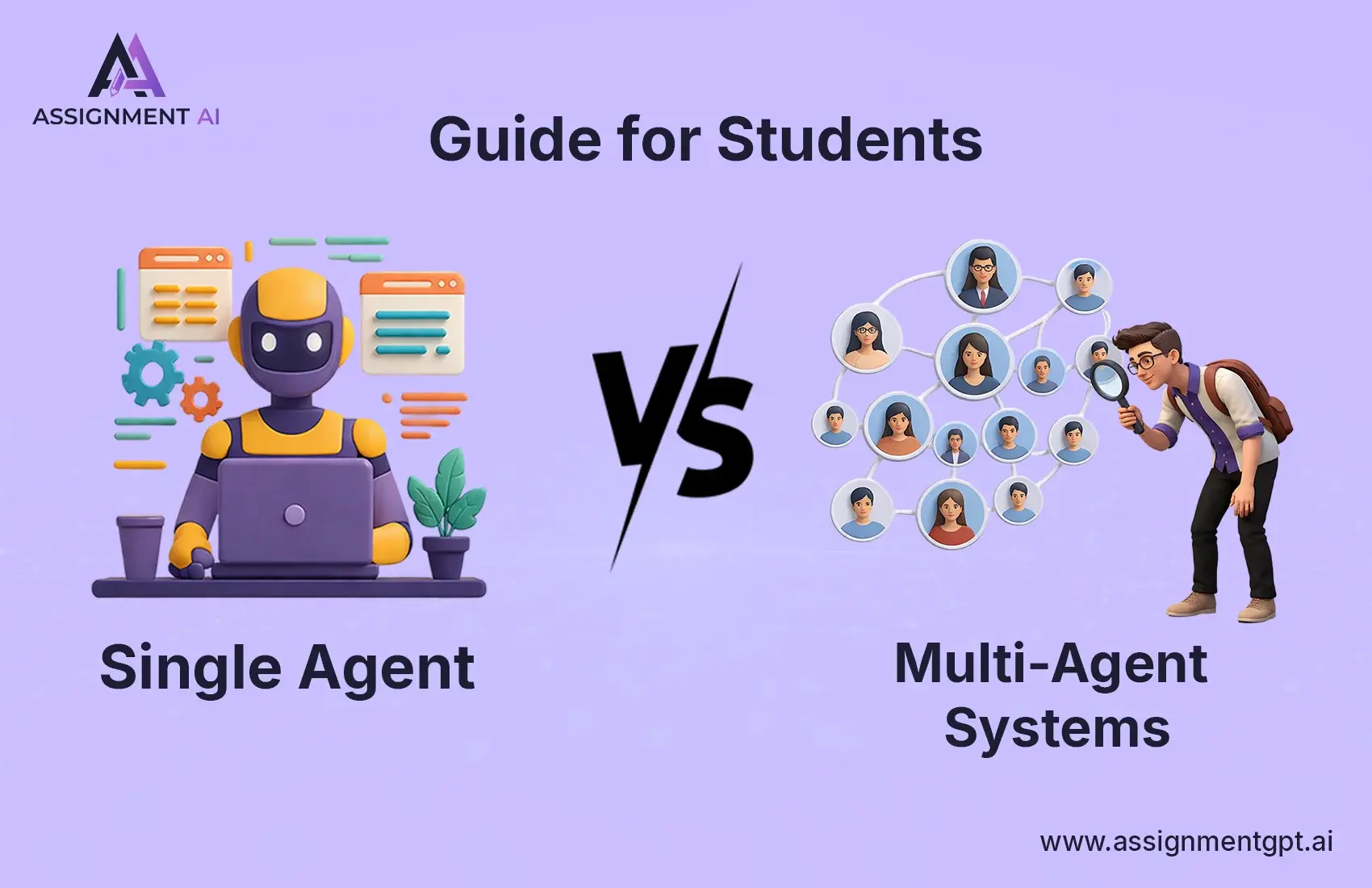
Agents serve as the interactive components of artificial intelligence systems. Depending on your problem requirements, you can choose between using a single agent or deploying multiple agents to work together.
This guide explains single-agent and multi-agent systems, including their differences and the appropriate situations for selecting each system. The course requires no previous knowledge because we will introduce all the content, starting from basic concepts.
What Is an AI Agent?
Before comparing these two types of systems, let's first make sure you understand what a proper AI agent even is.
An AI agent is a software program that can:
- Perceive its environment (receive input like text, data, or sensor readings)
- Reason about what to do next
- Act to achieve a goal (write a response, search the web, run code, etc.)
Think of it like a smart assistant that doesn't just answer questions it can actually do things. A good example is an AI that can browse the web, write a summary, and send it to your email, all by itself.
The key idea is autonomy an agent can operate without someone telling it every single step to take.
What Is a Single Agent System?
A single agent system is exactly what it sounds like: one AI agent handling everything on its own.
The agent receives a task, develops a plan, performs the plan through its various stages, and creates an outcome through its own efforts.
Simple analogy: Imagine a solo freelancer who takes on a project, does all the research, writing, and editing themselves, and delivers the final product. That's a single agent.
In practice, a single agent might:
- Receive a question like "Summarize the top 5 AI news stories this week."
- Search the web for relevant articles
- Read and process the content
- Write a clean summary
- Return the output to the user
Advantages of Single Agent Systems
Single-agent systems have real strengths, especially for simpler or well-defined tasks:
- Simplicity: Easier to build, test, and debug. There's only one "brain" to worry about.
- Predictability: You know exactly which agent made which decision. No confusion about who did what.
- Lower cost: Fewer components means fewer resources needed to run the system.
- Faster for simple tasks: Without coordination overhead, a single agent can complete straightforward tasks quickly.
- Easier to maintain: Updates and fixes only need to be applied in one place.
For students or developers just getting started with AI agents, single-agent systems are the natural starting point. Tools like GitHub Copilot are a great real-world example they function as a single-agent system that reads your current code context and generates intelligent suggestions.
Limitations of Single Agent Systems
- Limited parallelism: One agent handles one thing at a time. Long or complex tasks can take much longer.
- No specialization: A single agent is a generalist; it may not be great at every subtask involved in a complex problem.
- Context overload: If a task requires remembering a lot of information across many steps, a single agent can lose track or exceed its memory limits.
- Single point of failure: If the agent makes a mistake early in the process, there's no backup to catch the error.
- Scalability issues: As tasks grow more complex, the single agent can become a bottleneck.
What Is a Multi-Agent System?
A multi-agent system (MAS) uses multiple AI agents working together to solve problems. The agents within the system have distinct roles that they use to interact with each other for better task achievement.
Simple analogy: Think of a company that has separate departments for marketing, engineering, and finance. The different departments work independently while all striving toward the same company objectives. A multi-agent system operates in the same way.
In a multi-agent setup, you might have:
- A planner agent that breaks down a big task into subtasks
- A research agent that gathers information
- A writer agent that drafts content based on the research
- A reviewer agent that checks the output for quality
Each agent focuses on what it does best, and together they produce a result that no single agent could match alone. To see how this paradigm is already reshaping education, check out this overview of AI agents in education.
Advantages of Multi-Agent Systems
- Parallel processing: Multiple agents can work on different parts of a problem at the same time, dramatically speeding things up.
- Specialization: Each agent can be optimized for its specific role, leading to better overall results.
- Scalability: Need to handle more work? Just add more agents. The system grows with your needs.
- Error checking: One agent's output can be reviewed or validated by another, reducing mistakes.
- Resilience: If one agent fails, others can continue or compensate.
- Complex problem-solving: Tasks that are too large or complex for one agent become manageable when split across many.
Multi-agent systems demonstrate exceptional strength in enterprise and research environments that require handling extensive, diverse, and critical tasks.
Limitations of Multi-Agent Systems
- Complexity: More agents mean more moving parts. Coordinating them requires careful design.
- Higher cost: Running multiple agents simultaneously uses more compute resources and can be expensive.
- Communication overhead: Agents need to share information with each other, which takes time and can introduce delays or errors if not handled properly.
- Debugging difficulty: When something goes wrong, figuring out which agent caused the problem can be tricky.
- Coordination failures: If agents give each other conflicting instructions or duplicate each other's work, the whole system can break down.
- Harder to build: Designing a well-coordinated multi-agent system requires more advanced knowledge and testing.
Single Agent vs Multi-Agent: Side-by-Side Comparison
Here's a quick reference table to help you see the differences at a glance:
| Feature | Single Agent System | Multi-Agent System |
|---|---|---|
| Number of agents | One | Two or more |
| Task complexity | Simple to moderate | Moderate to complex |
| Specialization | Generalist | Specialized roles |
| Speed (complex tasks) | Slower | Faster (parallel work) |
| Cost | Lower | Higher |
| Ease of setup | Easy | More complex |
| Scalability | Limited | High |
| Error checking | Limited | Can be built in |
| Debugging | Easier | More difficult |
| Failure tolerance | Low (single point) | Higher (redundancy) |
| Best for | Focused, well-defined tasks | Large, multi-step tasks |
Real-World Examples of an AI Agent System
Let's dive into the real world to see how these systems come into play.
Single Agent in Action
- Customer Support Chatbot: A company implements an AI agent on its website. The agent searches the knowledge base to find the answer after the customer inputs their question. The work is finished with one completed task and one active agent.
- Personal AI Assistant (like a voice assistant): When you ask your phone's AI to "set a timer for 10 minutes," a single agent interprets your request and carries it out. Simple and efficient.
- Code Autocomplete Tools: Tools like GitHub Copilot operate as single agents they receive your current context and suggest the next lines of code.
Multi-Agent in Action
- AI-Powered Research Pipeline: A research platform operates through multiple agents a database searcher, a document analysis and summary agent, a source contradiction verification agent, and a final report writing agent. The workflow needs multiple agents to function correctly.
- Automated Software Development: Platforms like Devin function as AI software engines that develop software through a multi-agent system that handles planning, coding, testing, and code review through distinct components. This trend reflects the broader rise of AI in coding and how automated systems are transforming development workflows.
- Supply Chain Management: Large companies use multi-agent systems to track inventory levels, forecast demand, conduct supplier negotiations, and create delivery schedules simultaneously.
- Healthcare Diagnostics AI: A hospital might use one agent to analyze patient symptoms, another to cross-reference medical records, another to check for drug interactions, and a final agent to compile a recommended treatment plan.
When Should You Use Which?
Not every problem needs a team of agents. Here's a simple framework to help you decide:
Choose a Single Agent when:
- The task is clearly defined and not too complex
- Speed and simplicity matter more than depth
- Budget and computing resources are limited
- You're prototyping or learning
Choose a Multi-Agent System when:
- The task is large, multi-step, or requires different types of expertise
- You need tasks to run in parallel to save time
- Error-checking and validation are important
- The system needs to scale with growing workloads
- Different parts of the problem are genuinely independent
A good rule of thumb: start with a single agent. If you hit its limits if it's too slow, too error-prone, or too overwhelmed by the task that's your signal to consider a multi-agent approach. Understanding the difference between agentic AI and generative AI can also help you make a more informed architectural decision as your projects grow.
Conclusion
The decision between using single-agent systems or multi-agent systems depends on the specific characteristics and size of the problem at hand. Single-agent systems provide simple and efficient solutions that organizations can implement to complete focused tasks.
Multi-agent systems offer flexible, scalable solutions that teams can use to handle complex workflows requiring multiple specialized components working in concert.
The development of artificial intelligence needs professionals to comprehend both frameworks to move the field forward. Whether you're a student, developer, or enthusiast, mastering these concepts will sharpen your ability to design AI solutions that are truly fit for purpose and ready for the challenges ahead.
FAQs
1. What is an AI agent in simple terms?

2. How does a single agent system work?
3. What are the main benefits of using one AI agent?
4. When should I avoid using a single agent?
5. What exactly is a multi-agent system?
6. How do agents talk to each other in a team?
7. Why are multi-agent systems faster for big projects?
8. Is it expensive to run multiple AI agents?
9. Can multi-agent systems help reduce AI mistakes?
10. What makes multi-agent systems hard to build?
11. What is a real-world example of a single agent?
12. Can you give an example of a multi-agent system?
13. Which system is better for a student project?
14. Does a multi-agent system need more memory?
15. How do I decide between single and multi-agent?
Digital Marketer | SEO
I’m Dipak Dangodara, the SEO Expert at AssignmentGPT AI. I manage and optimize the website’s search engine presence with a strong focus on organic growth, visibility, and performance. My work includes technical SEO, keyword research, on-page and off-page optimization, and tracking SEO performance to align with search engine best practices.
At AssignmentGPT AI, my goal is to build sustainable rankings, improve traffic quality, and ensure the platform delivers long-term value through effective SEO strategies
Master AI with
AssignmentGPT!
Get exclusive access to insider AI stories, tips and tricks. Sign up to the newsletter and be in the know!
Transform Your Studies with the Power of AssignmentGPT
Empower your academic pursuits with tools to enhance your learning speed and optimize your productivity, enabling you to excel in your studies with greater ease.
Start Your Free Trial ➤Related Articles
OpenAI Superapp 2026: ChatGPT & Codex for Students
OpenAI's superapp merges ChatGPT, Codex, and a browser into one desktop app. Here's what every student needs to know in 2026.
MiMo V2 Pro vs GPT-5.2 vs Claude Opus 4.6: Best AI 2026
MiMo-V2-Pro, GPT-5.2, or Claude Opus 4.6 which AI model wins in 2026? We break down benchmarks, pricing, and the best pick for students and developers.

What Is GPT-5.4 Mini? Speed, Pricing & Use Cases (2026)
GPT-5.4 mini is faster, cheaper, and free on ChatGPT. Here's what students need to know in 2026.
What Is NemoClaw? NVIDIA AI Agent Tech for USA Students
NVIDIA NemoClaw is an open-source AI agent platform built for enterprise use - here's what every US student should know.
Perplexity Computer Explained: The AI Agent for Students
Perplexity Computer is the AI agent that handles your full study workflow research, writing, and more while you focus on other things.
Claude Opus 4.6 Review: Features, Pricing & Performance 2026
Claude Opus 4.6 is Anthropic's most powerful coding model. See its features, pricing, benchmarks, and if it's worth the cost.
Start your success story with Assignment GPT! 🌟 Let's soar! 🚀
Step into the future of writing with our AI-powered platform. Start your free trial today and revolutionize your productivity, saving over 20 hours weekly.
Try For FREE ➤