
AssignmentGPT Blogs

How Educators Are Balancing AI Innovation With Academic Integrity

Get an AI summary of this post on:




The current educational system operates with artificial intelligence technology because teachers appreciate its benefits, while students use it and schools research their allowed applications. The presence of AI tools such as ChatGPT and AssignmentGPT AI enables students to complete their tasks more rapidly while establishing writing standards. To understand how this shift is unfolding across classrooms, it helps to explore the rise of AI in education and what it means for both learners and institutions. The educators face difficulties in establishing their academic boundaries. Let us explain everything.
Why This Topic Matters More Than Ever
The academic integrity definition used to include only the detection of copy-paste plagiarism, but today it handles more complex issues. A student can ask an AI to write an entire essay in seconds, and the result often sounds perfectly human.
Recent surveys show that more than 60% of college students acknowledge using AI to complete their assignments. That's not a small number. And a good chunk of them aren't sure if it's even allowed.
Educators possess divided opinions about artificial intelligence implementation in educational settings. Some educators view AI as an effective educational resource. Some educators implement total bans on AI technology. Some educators need guidance about which policies to implement. The current debate will persist. The volume of the discussion continues to increase. Schools that choose to disregard the matter will experience future consequences.
The Core Problem: AI Is Ahead of Policy
Here's what's happening in most schools right now:
- AI tools are widely available and free to use
- Most academic integrity policies were written before AI existed
- AI detection tools are inconsistent and often unreliable
- Students don't always know where the line is
This creates a messy situation. Students aren't necessarily cheating on purpose — many genuinely don't know what's allowed. And educators are enforcing rules that don't quite fit the reality they're facing.
How Educators Are Responding: Practical Approaches That Work
1. Redefining What "Academic Integrity" Means
The previous definition of plagiarism, which states that people should not copy others' work, does not suit AI applications. The student who uses AI to generate ideas for their essay but writes the essay independently — does that activity qualify as cheating?
Smart educators are updating their definitions. They now investigate student material engagement instead of checking whether students used AI. The learners need to demonstrate their capacity to explain their academic work. Understanding how AI content detection works is becoming an important part of this updated approach to academic integrity.
The learning results should determine which tools students can use. The current situation needs to learn from previous practices.
2. Designing AI-Resistant Assignments
Some educators aren't fighting AI — they're designing around it.
The requirements for assignments include the following components:
- In-class writing needs to be conducted under conditions that restrict AI tools.
- Personal reflection essays require students to write about their particular life experiences.
- Oral presentations require students to describe their concepts through verbal explanation.
- Students need to submit all their process-based work, which includes drafts, notes, and revisions.
The research focuses on particular events or data that the AI systems cannot generate through their standard methods. The AI systems remain present in the research methods, although the research methods make it harder to use AI for shortcut purposes.
3. Teaching AI as a Skill
The current educational system needs to incorporate AI literacy as a fundamental skill because teachers now recognize this need.
Students will require AI skills for their future employment. The educational system fails to prepare students for real life because it does not teach them about the widespread use of AI technology.
Some educators choose to teach students responsible AI usage instead of implementing an AI ban. Students will learn to verify information created by AI systems. Students will discover how to use AI systems as initial resources rather than complete solutions. Students will learn to combine AI-generated content with their personal writing and analytical skills. Exploring the benefits of using AI writing tools can help both educators and students understand where responsible AI use adds genuine academic value.
Tools like AssignmentGPT AI are designed with this in mind, helping students brainstorm, structure ideas, and learn from AI assistance rather than just copying it. Platforms like AssignmentGPT AI provide important assistance to this task. The platform assists educators and students in finding AI tools that have been specifically developed for educational purposes rather than automatic output generation.
4. Setting Clear AI Use Policies (Per Assignment)
Blanket bans don't work. Neither does blanket permission.
The most effective approach is assignment-level transparency. Educators are starting to classify each assignment into one of three zones:
| Zone | What It Means |
|---|---|
| No AI | The student must do all the work independently |
| AI-Assisted | Students may use AI for research, brainstorming, or editing with disclosure |
| AI-Collaborative | Students can use AI as a co-creator, but must reflect on the process |
The system provides students with a better understanding, while teachers receive more freedom to choose their methods. The system is easier to implement than a standard rule that applies to all situations. Educators looking for guidance on how to avoid AI detection pitfalls in student work will find that clear per-assignment policies reduce ambiguity for everyone involved.
5. Using AI Detection With Caution
Detection tools for artificial intelligence exist. Tools like Turnitin, GPTZero, and Copyleaks claim to detect content that artificial intelligence has generated.
The system fails to provide reliable results, which demonstrate its inability to function as an academic assessment tool. The system produces false positive results regularly. The system has shown incorrect results for students who possess advanced writing abilities. The system shows a higher error rate for people who speak English as their second language.
Academic integrity experts recommend using these tools to assess a variety of evidence instead of treating them as single proof elements.
Best Tools and Strategies for Educators Right Now
If you are an educator seeking to navigate this area, here are today's most effective tools and approaches.
For Detecting AI Use
- Turnitin AI Detection: Integrated with many LMS platforms; decent but not foolproof
- GPTZero: Designed specifically for educators; offers classroom-specific features
- Copyleaks: Supports over 100 languages; useful for international students
For a broader comparison of available options, reviewing the best AI content detection tools can help educators identify which solution best fits their institutional needs.
For Teaching Responsible AI Use
AssignmentGPT AI: Designed to help students learn with AI, not just from it. It supports structured writing, citation assistance, and guided learning, making it a strong choice for educators who want to integrate AI constructively.
Findmyaitool: A discovery platform where educators can explore and compare AI tools across categories. If you're looking for the right tool for a specific teaching goal, it's a smart starting point.
For Policy Development
- ISTE AI in Education Resources: K-12 and higher education policy research, supporting data frameworks
- UNESCO AI Competency Framework: Guidelines for ethics and literacy of AI that should be internationally advanced in education
Common Mistakes Educators Make With AI Policy
Let's talk about what doesn't work.
Mistake 1: Issuing a blanket ban without enforcement tools: The policy creates anxiety without achieving any results because the institution cannot detect AI use yet. The rules make it harder for students who choose to follow them. The students who break the rules receive benefits.
Mistake 2: Treating all AI use as cheating: Using AI to brainstorm is fundamentally different from using AI to write your entire assignment. The absence of this distinction in policies results in both unfairness and lack of enforcement capability. Understanding whether using AI is truly cheating and where the ethical lines lie is key to building fair policies.
Mistake 3: Not involving students in the conversation: The best AI policies are built collaboratively. Once students understand why a rule exists rather than merely what it means, there is more compliance.
Mistake 4: Assuming AI detection tools are infallible: The danger of posing false accusations and undermining trust lays here when reliance on only one method for evaluation, the machine-based detection system, is employed.
Mistake 5: Ignoring the issue entirely: Some institutions are taking a wait-and-see approach. The reason for this behavior may be understandable, but waiting longer results in greater normalization of operational violations.
Pro Tips for Educators
Here are a few high-impact moves you can make right now:
Run an AI transparency exercise: Students need to submit their assignments first before they can share their work process. The students need to explain their sources of ideas and their usage of tools. The process establishes metacognitive skills while you gain an essential understanding of your students.
Add an AI disclosure field to assignment submissions: Transparency should be normalized through the development of procedures that enable students to declare their AI usage throughout their work. Students will show their actual behavior when you provide them with a secure method to reveal information.
Use AI as a classroom tool yourself: You must demonstrate to students both the results produced by artificial intelligence systems and their limitations. Show the system's inability to handle subtle meanings, its tendency to deliver incorrect information, and its production of standard text. This approach develops practical critical thinking skills about artificial intelligence technology. The best AI tools for teachers can serve as a great starting point for educators who want to explore firsthand how these tools perform.
Partner with your librarians: AI literacy resources and workshops are already being brought together by many academic librarians.
Check what Findmyaitool has listed: Start by not defaulting to a single AI tool. Users can filter out tools that are educationally appropriate, with good descriptions for each one.
Future Trends: Where This Is Heading
The landscape is shifting fast. Here's what's coming in the next 12 to 24 months:
Personalized AI tutors will become mainstream: Tools that adapt to an individual student's learning gaps and track their progress over time are already in development. Academic integrity policies will need to account for these. The broader conversation around AI agents in education gives a strong sense of where this personalized learning trend is heading.
AI-native assessments will emerge: Rather than trying to ban AI from tests, some institutions will design assessments that require AI and measure how well students prompt, evaluate, and build on AI output.
Accreditation bodies will weigh in: Expect formal guidelines from national and international accreditation organizations within the next few years. Schools that have already built thoughtful policies will be ahead of the curve.
Watermarking and provenance tools will improve: Efforts are underway to embed invisible metadata in AI-generated text so its origins can be traced. This won't solve everything, but it will change the detection landscape.
AI literacy will be added to core curricula: Just as digital literacy became a standard competency, AI literacy is moving in the same direction. Schools that treat this as a future problem are already behind. Staying current with emerging education trends will help institutions prepare for this shift before it becomes unavoidable.
Conclusion
AI functions as an educational tool, although improper use of technology serves as the actual problem. The educators who achieve success in their work dedicate their efforts towards creating better educational experiences. They develop academic frameworks that protect their academic vision by creating educational methods for learning in an AI world.
The plan needs to establish a better definition of what it needs to achieve. The plan needs to develop assessment methods that allow for more innovative testing solutions. The plan needs to establish assessment methods that use direct student interactions as their primary evaluation tool. The plan requires the use of AssignmentGPT AI, which serves as a case study for responsible AI execution.
The AIChecker platform provides educators with an efficient way to discover suitable resources for particular educational requirements. The schools that develop their programs through careful planning will equip students with essential competencies for their future endeavors.
FAQs
1. What is academic integrity in the age of AI?

2. Are students allowed to use AI tools for assignments?
3. How are teachers detecting AI-written assignments?
4. Is using AI for homework considered cheating?
5. What are the best AI tools for students to use responsibly?
6. Why are AI detection tools not fully reliable?
7. How can teachers design assignments that reduce AI misuse?
8. What is an AI use policy in schools and why does it matter?
9. What will AI in education look like in the next few years?
10. How can students use AI ethically for their studies?
Digital Marketer | SEO
I’m Dipak Dangodara, the SEO Expert at AssignmentGPT AI. I manage and optimize the website’s search engine presence with a strong focus on organic growth, visibility, and performance. My work includes technical SEO, keyword research, on-page and off-page optimization, and tracking SEO performance to align with search engine best practices.
At AssignmentGPT AI, my goal is to build sustainable rankings, improve traffic quality, and ensure the platform delivers long-term value through effective SEO strategies.
Master AI with
AssignmentGPT!
Get exclusive access to insider AI stories, tips and tricks. Sign up to the newsletter and be in the know!
Transform Your Studies with the Power of AssignmentGPT
Empower your academic pursuits with tools to enhance your learning speed and optimize your productivity, enabling you to excel in your studies with greater ease.
Start Your Free Trial ➤Related Articles
Free vs Paid AI Homework Tools for Students in 2026
Compare free and paid AI homework tools in 2026 to find the best option for saving time, money, and improving study support.

10 AI Tools Every College Student Should Use in 2026
Discover 10 powerful AI tools every college student should use in 2026 to study smarter, save time, boost productivity, improve learning, & achieve better grades.
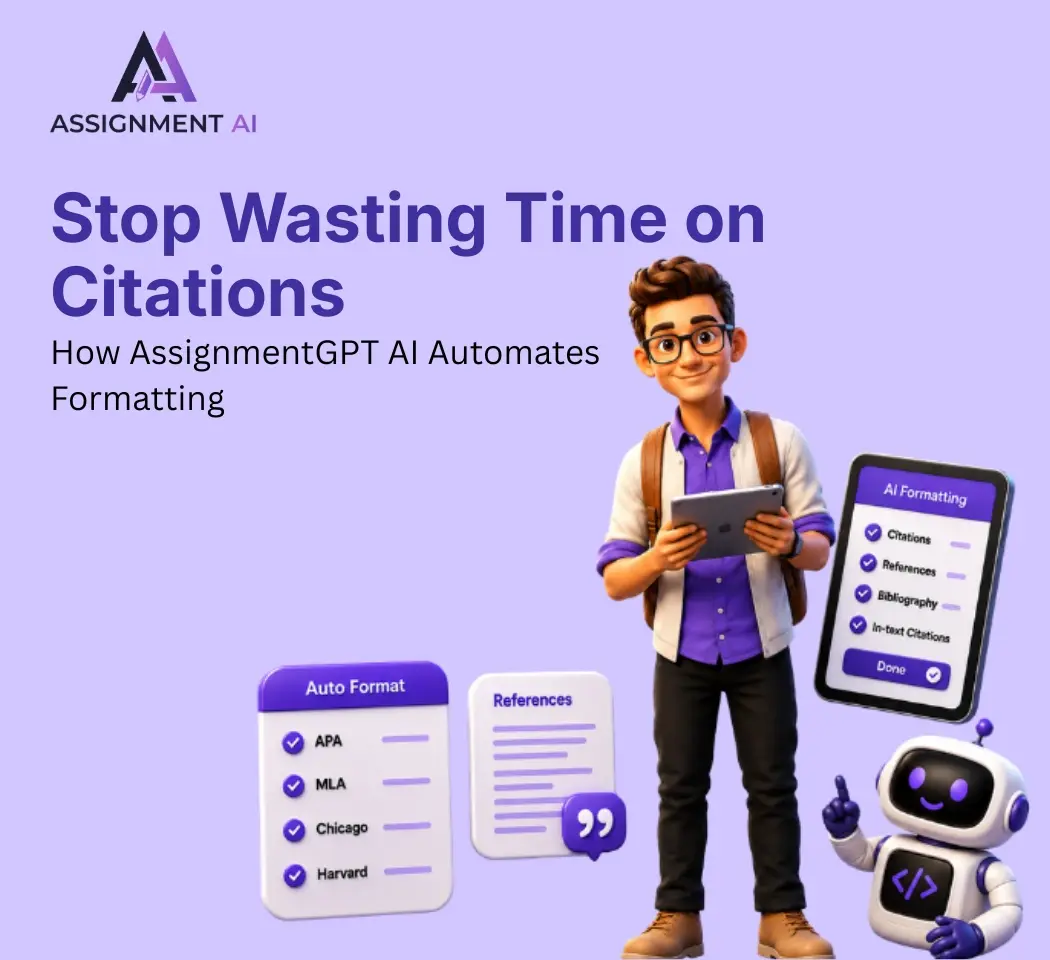
AssignmentGPT AI Citation Generator: Format Citations Fast
Create accurate APA, MLA, Chicago, and Harvard citations instantly with AssignmentGPT AI's free AI citation generator.
Is Turnitin's AI Detector Disabled in 2026? Full Guide
Turnitin's AI detector isn't gone, but Waterloo, Curtin, Yale and others have disabled it. Here's why, and what it means.
AI Homework Helpers: How They Are Changing Study Habits
AI homework helpers explain concepts step by step, helping students learn faster, study smarter, and build lasting confidence.
Best Flowchart Software Tools for Students and Developers
Compare the best flowchart tools for students, developers & engineers to create clear diagrams fast.
Start your success story with Assignment GPT! 🌟 Let's soar! 🚀
Step into the future of writing with our AI-powered platform. Start your free trial today and revolutionize your productivity, saving over 20 hours weekly.
Try For FREE ➤