
AssignmentGPT Blogs

Can AI Really Improve Student Performance? What the Data Says

Get an AI summary of this post on:





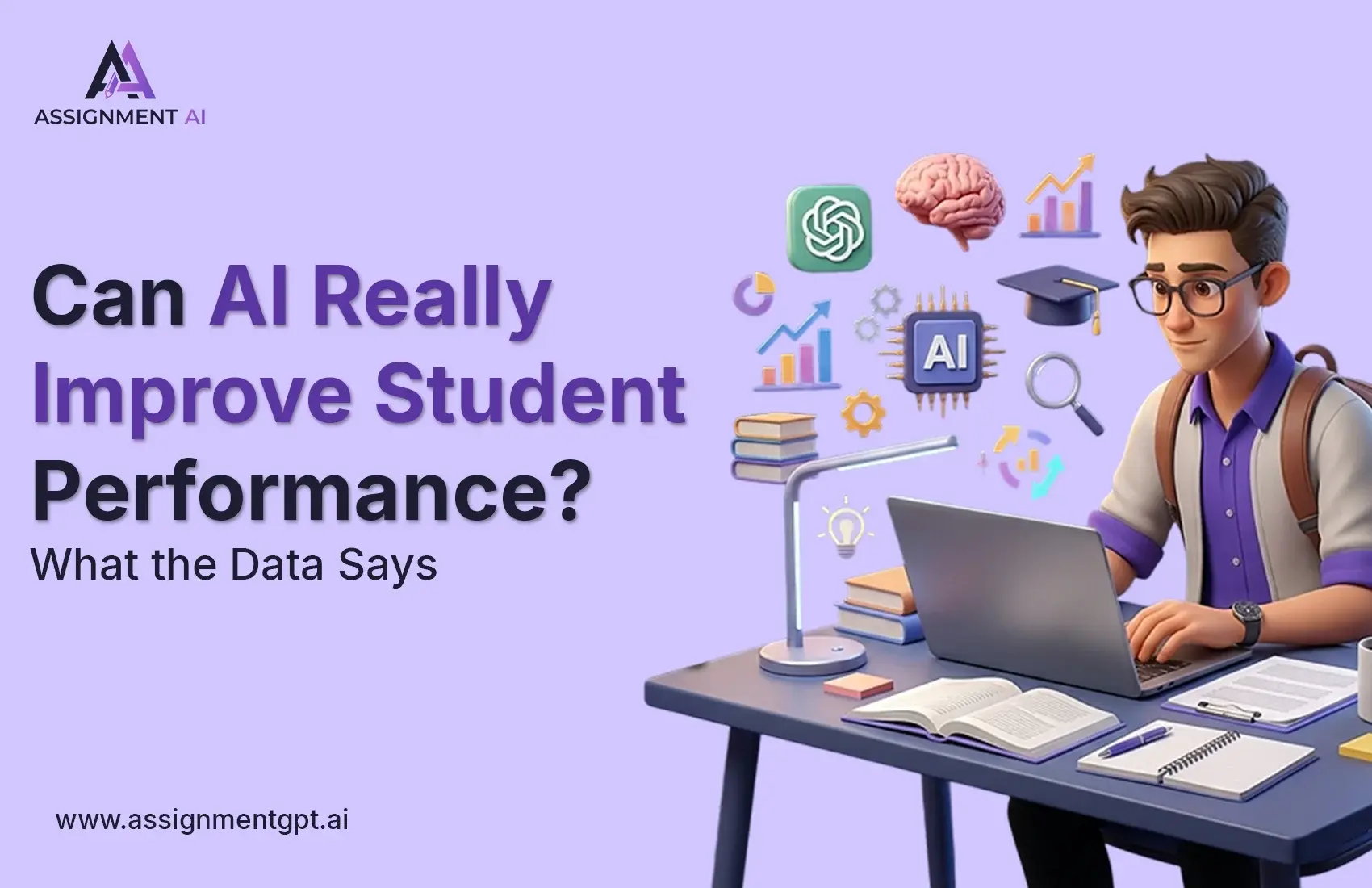
The current educational system puts students under greater stress than at any time in history. Students face multiple deadlines, which makes their studies difficult because they cannot comprehend the material. Students need new study techniques because traditional methods no longer meet their requirements. When AI tools began to enter educational settings, one research question needed answers: do these technologies improve student performance, or do they exist only as temporary trends? To understand what is really happening, it helps to look at how AI is transforming education and what the actual research tells us. The answer might surprise you.
Why This Question Actually Matters
The situation extends beyond academic discussion because it presents actual problems that affect parents, teachers, school administrators, and students.
Schools must adopt artificial intelligence systems at a faster rate because these systems provide actual performance improvements. The system wastes resources while creating adverse effects that will harm students' future capabilities.
The situation involves extreme risks. The actual evidence should be examined to confirm what the data demonstrates.
The Core Problem Students Face Today
The actual problem needs to be identified before we can discuss AI solutions. Most students don't struggle because they're lazy or incapable. The following reasons create obstacles that students must navigate to proceed with their studies.
- Learning is one-size-fits-all: A classroom of 30 students moves at one pace. Some fall behind. Some get bored. Both groups lose.
- Feedback is too slow: Students submit work, wait days for a grade, and by then, the concept is long gone from memory.
- Resources are scattered: Textbooks, YouTube videos, tutors, study groups — too much noise, not enough signal.
- Motivation drops fast: When students don't see progress, they disengage. It's a cycle.
AI addresses all four of these. Not perfectly, but meaningfully.
What the Research Actually Shows
Let's get specific. Here's what studies have found:
1. Personalized Learning Increases Retention
A 2023 Stanford study found that students using AI-powered adaptive learning tools retained information 40% more effectively than those using traditional methods. The reason? AI adjusts content difficulty in real-time according to the student performance data. The AI system advances through the class material based on your personal readiness instead of following the typical class schedule. Students who want to take full advantage of this shift can check out the best AI tools for students to find options that match their specific learning needs.
2. Instant Feedback Accelerates Learning
Research from MIT's Teaching and Learning Lab showed that students who received instant AI feedback on writing assignments improved their scores significantly faster than students who waited for human feedback.
The key insight: correction plus context equals learning. AI does not simply indicate incorrect answers but also provides explanations of errors and gives users specific guidance for resolving their mistakes.
3. AI Tutoring Narrows the Achievement Gap
The Gates Foundation report showed that AI tutoring tools benefited students from under-resourced schools more than any other student group. These students typically lack access to private tutors or extra academic support. AI systems provide all users with personalized learning pathways through their tutoring capabilities. This directly connects to the broader benefits of AI in education that researchers have been tracking across different school settings.
4. Engagement Goes Up When It's Done Right
The important point here needs to be understood. Passive AI tools, which require students to read AI-generated summaries, provide limited value for educational purposes. Interactive AI tools that require users to answer questions and reflect on their responses show users better engagement levels and performance results.
How AI Tools Actually Improve Student Performance
Below are the mechanisms that function in very specific ways:
Adaptive Quizzing
The system detects your weak points and conducts dedicated training for those areas. You only need to review specific materials instead of studying all the content. The platform AssignmentGPT AI employs this method to assist students in better managing their study periods.
Writing Assistance With Guardrails
Good AI writing tools function as writing assistants who help students improve their writing skills. The system identifies logical faults while it proposes more effective arguments and detects ambiguous statements. Human educators face challenges when they try to provide this type of feedback at scale to more than 30 students simultaneously. Students looking to sharpen this skill can also benefit from reading essential writing tips for better academic output.
Concept Explanation on Demand
Students often hesitate to ask "basic" questions in class. AI removes that hesitation. The user can repeat the same question five times until they understand the answer without facing any judgment or time constraints.
Study Planning
AI creates a study plan that matches the student's actual schedule, adjusting priorities based on upcoming deadlines and personal learning pace.
A Quick Comparison: Traditional vs. AI-Assisted Learning
| Factor | Traditional Learning | AI-Assisted Learning |
|---|---|---|
| Feedback Speed | Days to weeks | Instant |
| Personalization | Low (class-wide pace) | High (individual pace) |
| Access to Support | Limited (teacher hours) | 24/7 |
| Cost of Tutoring | High | Low to free |
| Engagement Tools | Static | Interactive |
| Progress Tracking | Infrequent | Continuous |
Best AI Tools and Strategies for Students Right Now
For Writing: AssignmentGPT AI functions as a dedicated academic writing tool that assists students in crafting their work. The program enables students to build their arguments while achieving a better understanding of their ideas through writing and developing their personal writing style. The tool helps students become better writers through practice because it shows them how to complete assignments instead of showing them the final results.
For Finding the Right Tool: If you're not sure which AI tool fits your study needs, platforms like Findmyaitool are genuinely useful. The system enables students and educators to discover appropriate tools through its categorization of AI tools by their usage scenarios and required competencies.
For Subject-Specific Help: Great examples of subject-specific AI systems with real measurable results include Khanmigo from Khan Academy, PhotoMath for math problems, and Duolingo's AI features for language learning. Students struggling with math specifically can also look into free math problem solving websites and applications that complement AI tutoring tools.
For Study Planning: Notion AI and similar tools can help students develop structured weekly plans based on their real goals and deadlines.
Common Mistakes Students Make With AI
Here's where things go wrong:
1. Using AI to skip thinking: Students who study educational materials through direct copying of AI-generated essays will create dependency problems. The existing academic integrity tools already have the capability to identify this type of writing.
2. Treating every AI output as fact: The artificial intelligence system creates false information about events that did not happen. The system can provide answers with complete certainty while still being incorrect. Students need to verify, cross-check, and think critically about what AI tells them.
3. Using too many tools at once: Instead of spreading across ten different platforms, it is better to pick two or three and get as much depth as possible from each one.
4. Not engaging with the feedback: Students frequently receive AI feedback but choose to disregard the results. The situation resembles a player who requests coaching advice yet continues to perform in the same manner. The feedback should be utilized, or the requester should not make their request.
5. Relying on AI for motivation: Although AI can aid learning, it cannot instill discipline into scholars. Students still must attend class, try hard, and perform the work themselves. Building strong stress management techniques for students alongside AI use creates a much healthier and more effective study routine.
Pro Tips for Getting Real Results
If you want AI to actually move the needle on performance, here's what works:
- Start with a goal, not a tool Decide what you want to improve: writing, math, comprehension, then find the AI that targets that specifically.
- Use AI as a conversation partner Ask it to quiz you, challenge your reasoning, or explain concepts from multiple angles.
- Set a review routine Use AI for 20 to 30 focused minutes daily rather than cramming sessions that go nowhere.
- Compare your work before and after Track whether your grades, speed, or confidence are actually improving. If not, switch your approach.
- Use tools like Findmyaitool to discover newer AI options that might be a better fit as your needs evolve.
Students who want even more structure around their study habits can also read about how to finish your homework faster to combine time management with smart AI usage.
What's Coming Next: Future Trends in AI and Education
The tools we have now are early-stage compared to what will be developed in the future.
Emotion-aware AI will recognize student frustration and disengagement, which triggers the system to provide slower explanations through different formats and deliver encouragement to students.
AI-powered peer learning will provide tools that identify students with matching learning gaps and then support them in conducting organized study sessions.
AI dashboards will allow teachers to observe student support needs in real time during active classroom sessions.
AI-personalized learning paths will construct complete educational pathways that depend on a student's personal history, their academic objectives, and their preferred learning methods.
These systems exist in reality because their initial versions are currently undergoing testing in educational institutions. Keeping up with emerging education trends will help both students and educators stay ahead as these tools continue to develop rapidly.
Conclusion
Students do not achieve increased intelligence through AI. AI enables students to learn at a faster pace while receiving customized education and having better access to materials.
Active and intentional usage of AI tools leads to improved student performance according to the data. The students who benefit most are the ones who treat AI as a thinking partner, not a shortcut.
AssignmentGPT AI and Findmyaitool serve as effective, tested starting points for students, educators, and parents who need guidance. The technology reaches full operational capacity. The question is whether students are ready to use it effectively.
FAQs
1. Can AI tools actually improve student performance?

2. How does AI help students learn faster?
3. What are the best AI tools for students right now?
4. Is AI tutoring better than traditional tutoring?
5. Does using AI for studying count as cheating?
6. What mistakes do students make when using AI for studying?
7. How does AI personalize learning for each student?
8. Can AI tools help students who are falling behind in school?
9. How much time should students spend using AI study tools daily?
10. What is the future of AI in student education?
Digital Marketer | SEO
I’m Dipak Dangodara, the SEO Expert at AssignmentGPT AI. I manage and optimize the website’s search engine presence with a strong focus on organic growth, visibility, and performance. My work includes technical SEO, keyword research, on-page and off-page optimization, and tracking SEO performance to align with search engine best practices.
At AssignmentGPT AI, my goal is to build sustainable rankings, improve traffic quality, and ensure the platform delivers long-term value through effective SEO strategies.
Master AI with
AssignmentGPT!
Get exclusive access to insider AI stories, tips and tricks. Sign up to the newsletter and be in the know!
Transform Your Studies with the Power of AssignmentGPT
Empower your academic pursuits with tools to enhance your learning speed and optimize your productivity, enabling you to excel in your studies with greater ease.
Start Your Free Trial ➤Related Articles
Free vs Paid AI Homework Tools for Students in 2026
Compare free and paid AI homework tools in 2026 to find the best option for saving time, money, and improving study support.

10 AI Tools Every College Student Should Use in 2026
Discover 10 powerful AI tools every college student should use in 2026 to study smarter, save time, boost productivity, improve learning, & achieve better grades.
AssignmentGPT AI Citation Generator: Format Citations Fast
Create accurate APA, MLA, Chicago, and Harvard citations instantly with AssignmentGPT AI's free AI citation generator.
Is Turnitin's AI Detector Disabled in 2026? Full Guide
Turnitin's AI detector isn't gone, but Waterloo, Curtin, Yale and others have disabled it. Here's why, and what it means.
AI Homework Helpers: How They Are Changing Study Habits
AI homework helpers explain concepts step by step, helping students learn faster, study smarter, and build lasting confidence.
Best Flowchart Software Tools for Students and Developers
Compare the best flowchart tools for students, developers & engineers to create clear diagrams fast.
Start your success story with Assignment GPT! 🌟 Let's soar! 🚀
Step into the future of writing with our AI-powered platform. Start your free trial today and revolutionize your productivity, saving over 20 hours weekly.
Try For FREE ➤