
AssignmentGPT Blogs

The Future of Education: Will AI Replace Homework Completely?

Get an AI summary of this post on:





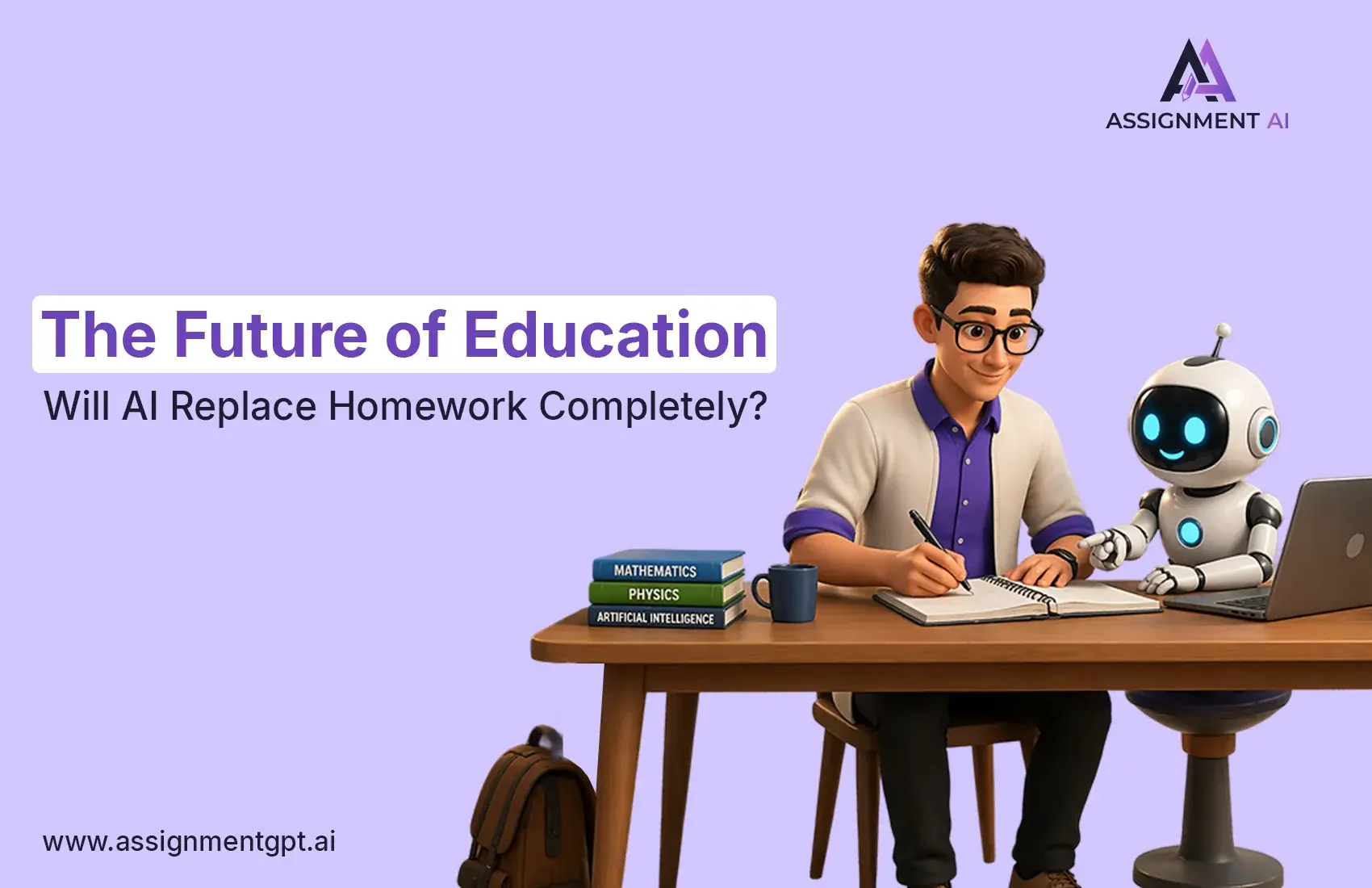
The present moment requires us to consider how our educational system functions in a world where students can access AI tools that generate instant responses to their questions. Students today complete their homework assignments by using ChatGPT, Google Gemini, and Microsoft Copilot to conduct research and create their work. If you want to understand the bigger picture of how AI transforms education, this shift is already well underway. The current situation raises a fundamental question that people must solve.
Will AI replace homework completely?
In this post, we'll explore what AI means for education, whether homework still has a place in modern learning, and what teachers, parents, and students can do to adapt smartly.
What Is AI Doing to Homework Right Now?
Let's be honest. Students are already using AI to:
- Write essays and assignments
- Solve math problems step by step
- Summarize chapters and textbooks
- Generate project ideas and presentations
- Even write code for computer science assignments
A 2023 survey conducted by Stanford University discovered that more than 60 percent of high school students had utilized AI tools to assist them with at least one school assignment. The usage of these tools continues to increase. The traditional model of homework, which requires students to work alone at home until they submit their work the next day, has reached its breaking point. The educational system is currently working hard to adapt to these changes.
The Pros for AI Replacing Homework
1. Personalized Learning at Every Level
Students who need to complete traditional homework assignments experience a major challenge because all students receive identical assignments. Students who already understand a particular concept find the 20 repetitive problems to be boring. The student who faces difficulties in learning experiences extreme stress.
AI changes this. Tools like Khan Academy's Khanmigo create personalized learning experiences by modifying question content and explanation details according to student progress. If you are exploring the best AI homework helper tools for students, adaptive learning platforms consistently outperform standard worksheet exercises according to research evidence.
2. Instant Feedback vs. Waiting Until Monday
The student who completes their homework according to traditional methods experiences a delay of several days before receiving their test results. The concept becomes impossible to remember by that time.
AI provides students with immediate feedback that matches their individual learning needs. The system identifies the student's incorrect answer and provides two ways to explain the concept again for better understanding: one for the student to study himself and one for a teacher who has to handle 40 students at once.
3. Removing Inequality in Access to Help
Not every student has a parent who can help with algebra or essay writing. Not every family can afford a private tutor.
AI is becoming the great equalizer in education. A student in a small town with no access to tutoring can now get the same quality of explanation as a student in a top private school. For subjects like mathematics, tools such as an AI math problem solver can give every student access to step-by-step guidance regardless of their background. That is genuinely powerful.
The Cons of AI Replacing Homework
1. Critical Thinking Cannot Be Outsourced
Here is the uncomfortable truth: when AI thinks, the student does not learn.
The academic assignment reaches its highest level of effectiveness when it requires students to demonstrate their understanding through multiple stages of work instead of requiring them to produce one correct answer.
The process involves making errors, which students must then review and attempt to correct through their subsequent attempts. The process teaches students how to solve problems while developing their ability to handle challenges and helping them achieve complete comprehension of the material.
The student who requests AI to produce their essay will receive a text that contains correct grammar and structural elements, but they will lack essential skills required for constructing arguments, structuring their ideas, and expressing their concepts. These abilities serve as essential requirements for success in life because they extend beyond their academic purpose. This is a key reason why the debate around AI essay writing vs. writing it yourself continues to grow louder in academic circles.
2. Over-Reliance Creates a Dangerous Dependency
Think about GPS navigation. Many people today cannot read a physical map or estimate directions because they have outsourced that skill entirely to technology. A similar risk exists with AI and learning.
If students never struggle with a concept on their own, they may never truly own that knowledge. The moment they are in an exam, a job interview, or a real-world situation without AI access, the gap becomes obvious.
3. Academic Integrity Is Under Threat
Schools and universities around the world are facing a crisis of AI-generated plagiarism. Students submit AI-written work as their own, making it nearly impossible for teachers to assess actual understanding. Understanding whether using AI is considered cheating is now an essential conversation for every student and educator.
This is not just an ethical problem. It erodes the entire purpose of education, which is to certify that a person has genuinely learned something.
So, Will AI Replace Homework Completely?
The answer is not entirely. Nonetheless, homework as we know it will see a significant change.
Here is a more realistic picture of where we are heading:
The Homework of the Future Will Look Like This:
- Less rote repetition (AI handles drills better anyway)
- More project-based and creative tasks that require original thinking
- Collaborative assignments that involve human judgment and teamwork
- Reflection journals where students explain how they used AI tools and what they learned
- Oral assessments that cannot be faked with AI
Some schools in Finland, Singapore, and parts of the United States have already started to implement this educational approach. The schools do not prohibit AI use; they demonstrate to students how to use AI as a responsible tool. This aligns with the broader emerging education trends reshaping classrooms globally.
What Should Teachers, Parents, and Students Do Right Now?
1. For Teachers:
- Redesign assignments to include a reflection or explanation component (e.g., "Write this essay AND explain your reasoning in 5 bullet points")
- Teach AI literacy and help students understand what AI can and cannot do
- Use AI for administrative tasks such as lesson planning and feedback drafts, so you have more time for human connection in the classroom
- Assess process, not just product, by tracking how a student arrives at an answer
Teachers looking for practical support can explore a dedicated teacher bot to streamline classroom tasks and focus more time on actual student interaction.
2. For Parents:
- Do not panic, but do not ignore it either. Have open conversations with your children about how and when they are using AI
- Encourage your child to try first before turning to AI for help
- Focus on understanding, not grades. Ask your child to explain what they learned, not just what they submitted
3. For Students:
- Use AI as a tutor, not a ghostwriter. Let it explain concepts, not write your work for you
- Always ask yourself: Do I actually understand this? If not, keep working
- Practice doing hard things without help. Your brain, like a muscle, grows when challenged
- Be honest with your teachers about how you are using AI tools
Students who want structured guidance on working smarter can also explore time management tips to build better study habits alongside their AI use.
Real-World Examples: Schools Leading the Way
Example 1: Montclair High School, New Jersey
The school established an "AI Transparency Policy" which requires students to reveal their AI tool usage and their usage methods instead of banning AI. The system transformed from a cheating mechanism to a learning dialogue tool after this change.
Example 2: GEMS Education, Dubai
GEMS schools integrated AI-powered tutoring into their homework model. Students use AI to get hints and explanations, but they need to create a handwritten reflection to demonstrate their understanding of the material.
Example 3: iDiscoveri Schools, India
The schools implemented project-based learning which required students to complete homework that involved solving actual problems in their community. The students needed to solve problems that demanded them to use empathy, observation skills, and creative abilities, which AI systems could not duplicate. This model reflects the best practices found in the benefits of AI in education when applied thoughtfully rather than blindly.
Conclusion
The purpose of homework is to generate correct solutions, which has already been achieved by AI systems that now dominate this field.
The educational system needs to maintain its value for students when they study because education aims to develop students into curious, resilient, creative, and deep-thinking individuals. The educational system needs to implement different methods to accomplish its current goals.
The schools, teachers, and parents who ask "How do we help students grow?" instead of "How do we stop them from using AI?" will be the ones who shape the next generation of learners.
The future exists as a design project that we create through our actions.
FAQs
1. Will AI completely replace homework in the future?

2. Is it okay for students to use AI for homework help?
3. How is AI affecting students academically right now?
4. What are the biggest risks of using AI for homework?
5. How are schools dealing with AI and homework cheating?
6. Can AI make homework more personalized for every student?
7. What will homework look like in the next 10 years
8. Does using AI for homework affect critical thinking skills?
9. Are there schools that already teach students to use AI responsibly?
10. What should parents do about their child using AI for homework?
Digital Marketer | SEO
I’m Dipak Dangodara, the SEO Expert at AssignmentGPT AI. I manage and optimize the website’s search engine presence with a strong focus on organic growth, visibility, and performance. My work includes technical SEO, keyword research, on-page and off-page optimization, and tracking SEO performance to align with search engine best practices.
At AssignmentGPT AI, my goal is to build sustainable rankings, improve traffic quality, and ensure the platform delivers long-term value through effective SEO strategies.
Master AI with
AssignmentGPT!
Get exclusive access to insider AI stories, tips and tricks. Sign up to the newsletter and be in the know!
Transform Your Studies with the Power of AssignmentGPT
Empower your academic pursuits with tools to enhance your learning speed and optimize your productivity, enabling you to excel in your studies with greater ease.
Start Your Free Trial ➤Related Articles
Free vs Paid AI Homework Tools for Students in 2026
Compare free and paid AI homework tools in 2026 to find the best option for saving time, money, and improving study support.

10 AI Tools Every College Student Should Use in 2026
Discover 10 powerful AI tools every college student should use in 2026 to study smarter, save time, boost productivity, improve learning, & achieve better grades.
AssignmentGPT AI Citation Generator: Format Citations Fast
Create accurate APA, MLA, Chicago, and Harvard citations instantly with AssignmentGPT AI's free AI citation generator.
Is Turnitin's AI Detector Disabled in 2026? Full Guide
Turnitin's AI detector isn't gone, but Waterloo, Curtin, Yale and others have disabled it. Here's why, and what it means.
AI Homework Helpers: How They Are Changing Study Habits
AI homework helpers explain concepts step by step, helping students learn faster, study smarter, and build lasting confidence.
Best Flowchart Software Tools for Students and Developers
Compare the best flowchart tools for students, developers & engineers to create clear diagrams fast.
Start your success story with Assignment GPT! 🌟 Let's soar! 🚀
Step into the future of writing with our AI-powered platform. Start your free trial today and revolutionize your productivity, saving over 20 hours weekly.
Try For FREE ➤