
AssignmentGPT Blogs

ChatGPT in Education: Pros, Cons, Best Practices & Trends

Get an AI summary of this post on:





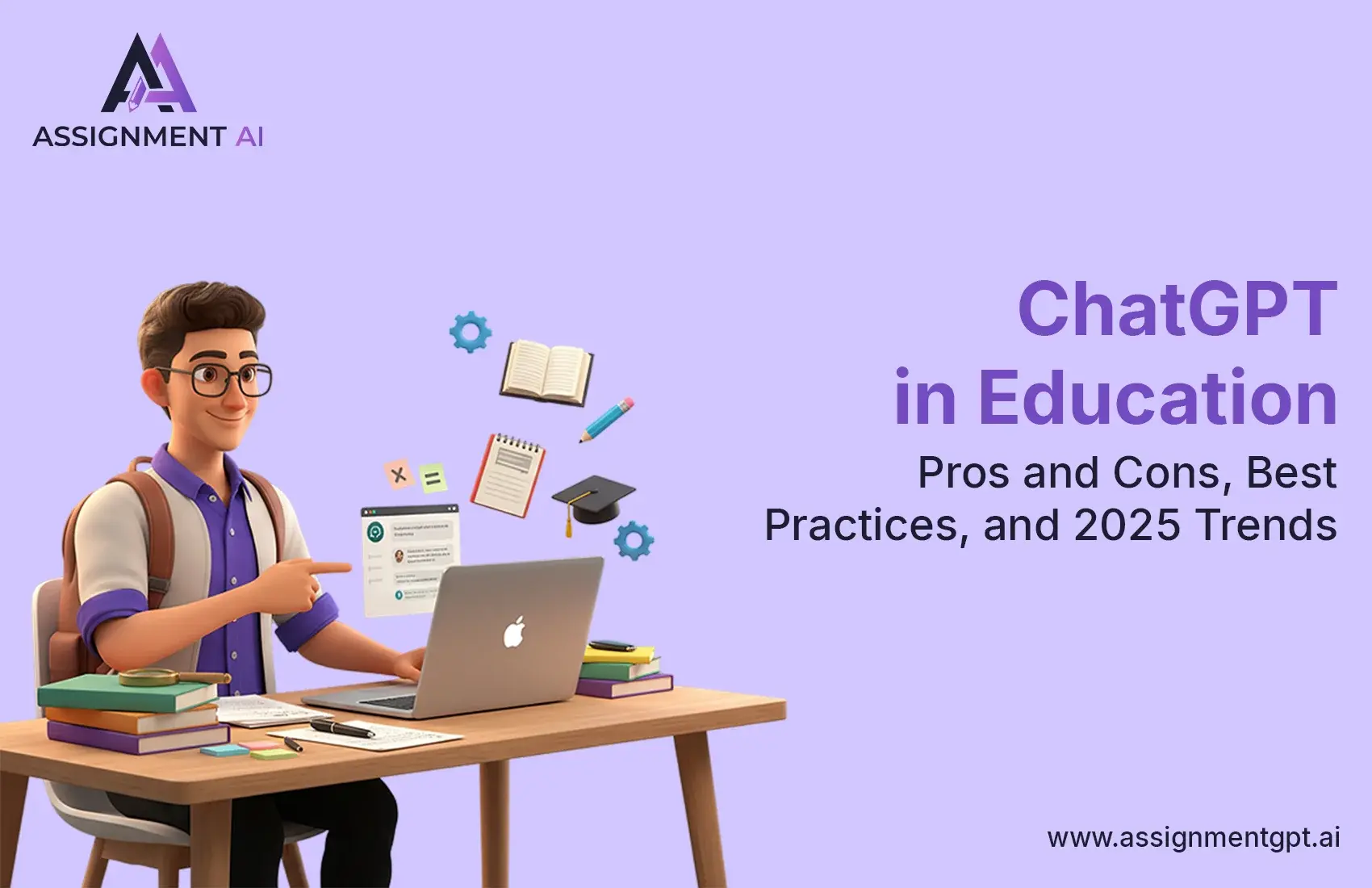
The digital era we live in has made it very visible that artificial intelligence is not only a tech trend but a partner in the education process. Amongst the various AI tools, ChatGPT has tremendously transformed the learning process from the student end, teaching methods by teachers, and the institutions' ways of scaling learning.
Not every output produced by ChatGPT is good and correct, and not every result obtained from it should be accepted as totally accurate without verification by an expert. This is simply the reason why teachers and students must be fully informed about its operations, about the situations when it works well, about those when it has complications, and most importantly, about how to employ it responsibly and effectively with a view to academic outcomes.
Today I'm going to show you, in this extensive article, ChatGPT and the top academic AI platform, and the discussions we will have will be about your academic tasks and the possibility of using it to enhance the productivity of your knowledge and time. I will share with you my experience about how ChatGPT or an AI platform has been beneficial for me.
Quick Summary
As we have seen, ChatGPT is one of the most Popular tools for educational purposes. Especially teachers, learners, students, and content creators often use ChatGPT to provide the best solution. As of now, ChatGPT has announced that this tool has been integrated with Microsoft Copilot. This is very beneficial for students.
However, ChatGPT is best for innovation and opens your learning skills. Nowadays, ChatGPT is a better assessment for teachers that can guide them on any specific topic, and, like students, as well as educators must use ChatGPT to enhance their skills.
Our focus in this article:
1. What is ChatGPT, and how does it prove helpful for academic tasks?
2. What are the pros and cons of using AI for academic tasks?
3. Is it ethical to use ChatGPT or an AI platform for academic tasks?
4. Based on my experience, I will recommend the best AI academic platform that I personally use.
What is ChatGPT and How Does It Work in Education?
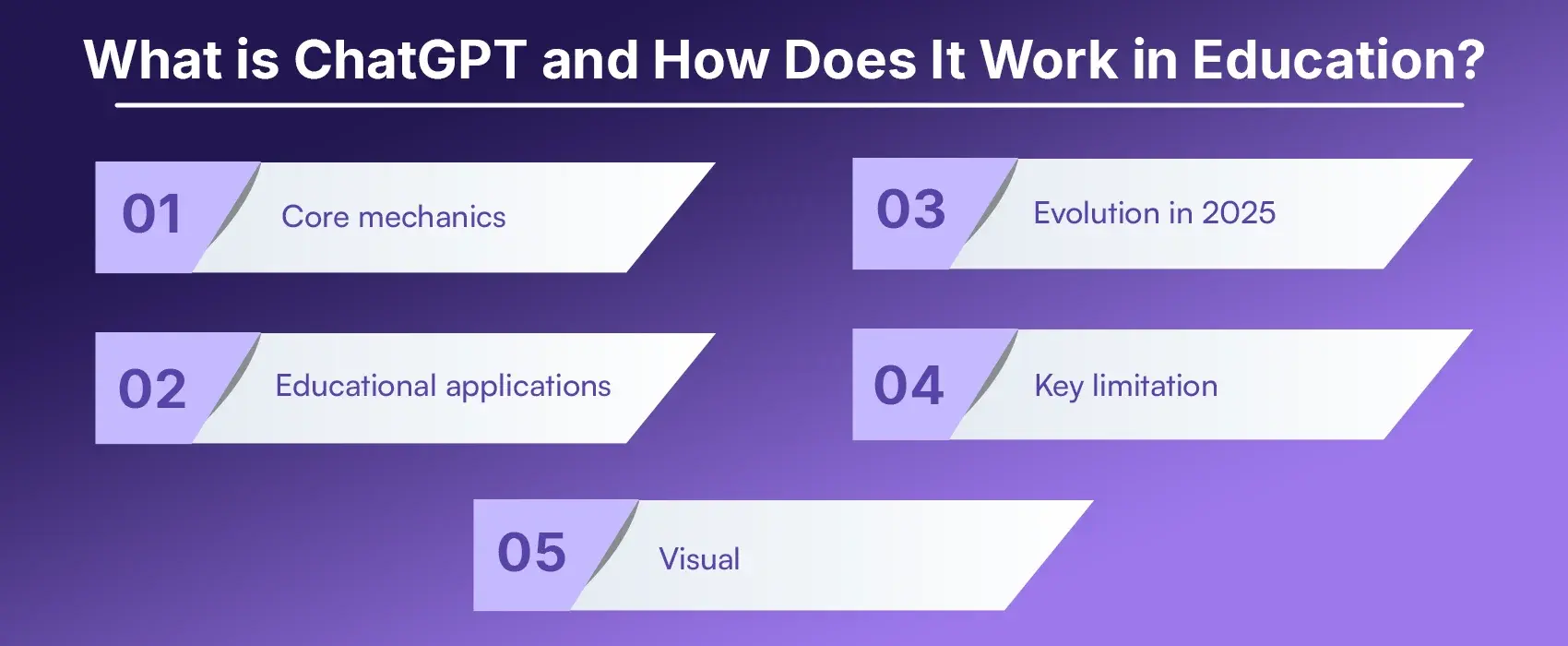
ChatGPT is, at its core, an artificial intelligence model for conversation developed by OpenAI that is very similar to the Generative Pre-trained Transformer (GPT) architecture.
The differential in learning is that it always works and comprehends language in the same manner as humans do by interpreting it through context, tone, and purpose.
ChatGPT is not the case that it collects information, keeps it, and then just restates it back to the user. ChatGPT monitors the patterns in a huge number of texts and then learns how ideas are interrelated, how questions are formed, and how to provide explanations.
How general students use ChatGPT
Thus, when a pupil poses a question such as, "Could you please clarify quantum physics for me as if I were twelve years old?" the AI does not merely respond but actually switches its whole teaching method to suit the student.
What is the core of ChatGPT, and what makes it so amazing, is the area underlying all of the words, that means it is supported by Natural Language Processing (NLP) to value it, plus reinforcement Learning from Human Feedback (RLHF), which creates and modifies answers so they continue to be in line with what people consider helpful or unhelpful, as an illustration of knowledge production.
In the field of education, ChatGPT is not merely a question-answer machine but has become the most flexible learning engine that can take up any role required by a student or teacher. Students are engaging with it for the purposes of brainstorming for their essays, clarifying difficult chapters, producing notes for each chapter, planning their study schedules, and, in addition, it is useful for managing time and organising daily activities.
My Personal Experience with ChatGPT for Academics
I found it interesting when I used ChatGPT for various subjects like biology, economics, history, and even calculus for advanced mathematics; the model altered its specificity and tone depending on the subject.
When it comes to science, it gets more visual and example-oriented, and when it comes to writing about history, it becomes more organised in essays. Math problems are presented more gradually. This kind of adaptability of the platform causes ChatGPT to appear less machine-like and more like a patient tutor in most cases, regardless of the time of day.
How Teachers and Professors Use ChatGPT
In the case of teachers, ChatGPT is a support tool of a different kind. The days when one would spend hours on worksheets, exams, or feedback for a dozen students are gone. High-quality drafts can now be produced in just a few minutes. It is not a question of educators being replaced; on the contrary, they are empowered to dedicate their time to teaching rather than handling paperwork.
There are a lot of teachers that I see who are using ChatGPT to create three variations of a lesson plan for different ability/skill levels in 15 minutes or less. That's the main reason most teachers opt for AI tools like ChatGPT.
Pros of ChatGPT in Education
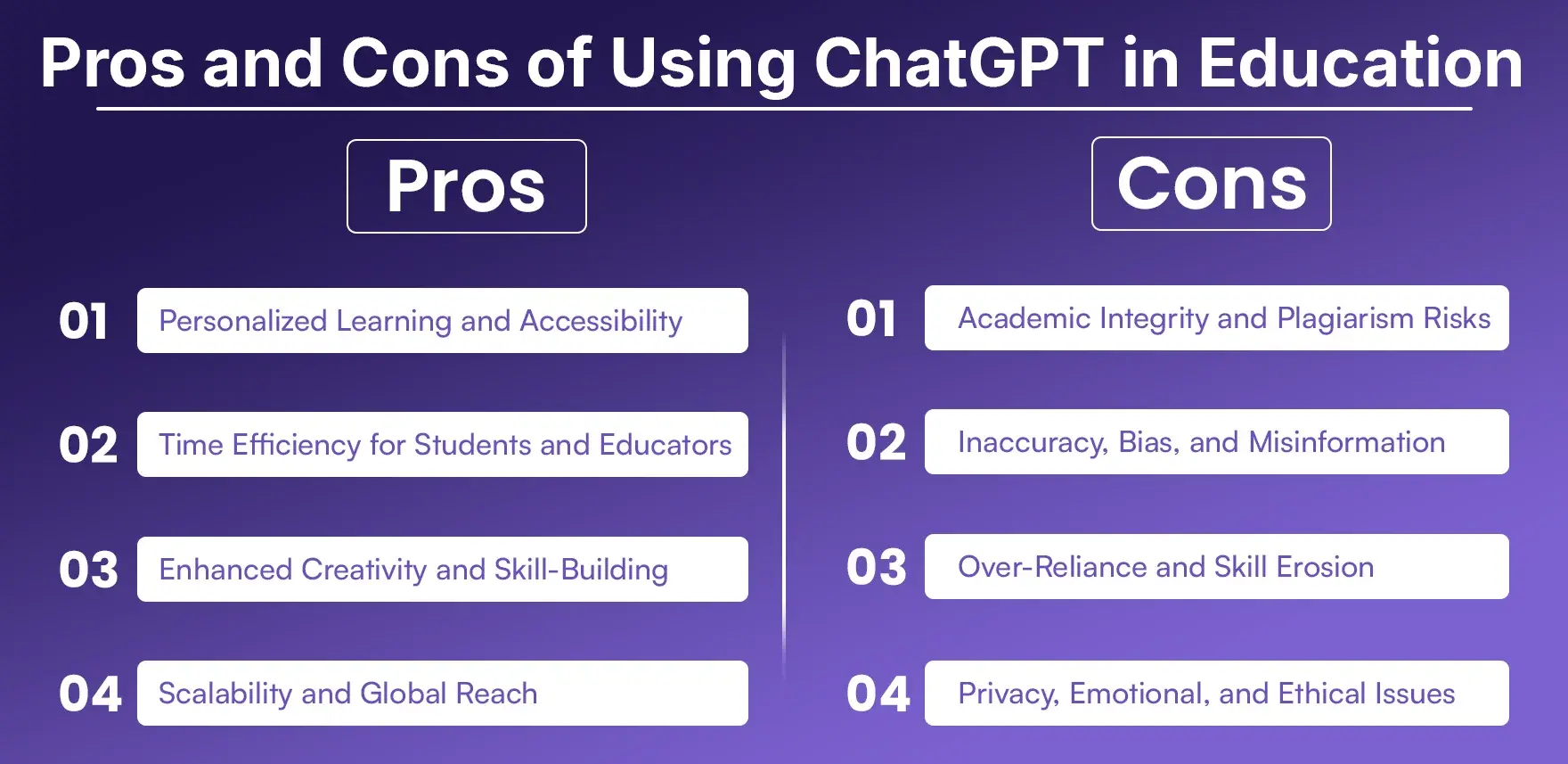
ChatGPT has made a big impact on education by introducing more interactive, personalised, and accessible learning experiences. It is like an automated virtual assistant that can help students when they have difficulties understanding something or teachers when they want support with mundane tasks.
In a recent survey, one-fourth (26%) of the students stated that they rely on ChatGPT for their studies. The reason for this is its capability to answer and adapt to different educational contexts and learning levels with explanations that are pertinent to each student's comprehension and learning style, thus making their educational journey more seamless and interesting.
1. Personalised Learning Assistance
ChatGPT offers individualised explanations, taking into account the pace, background, and understanding of the student. If the topic appears too complicated, it comes up with a condensed idea or a relatable one.
This is a great advantage for students who are quieter or more introverted and may not feel comfortable asking similar questions in class. In this way, the student is discovering clarity, gaining confidence, and personalising the educational experience to his/her needs, with every instance.
2. Prompt Responses and Speedy Trouble-Shooting
In the learning process, students' study rhythms are interrupted, but waiting for responses is a major source of annoyance. Fortunately, ChatGPT takes away this worry. No matter what the time is, students are able to get answers to any science, math, language, etc.
The 24/7 feature makes it possible for students to maintain their learning pace and their educational goals by easily answering their questions. This not only keeps the learning process ongoing but also, to some extent, prevents the feeling of being cut off from learning, thus maximising learning.
3. Assist in Assignment and Research Understanding
Not knowing where to start can lead to assignments and research being seen as a huge burden by students. ChatGPT is a student’s assistant by providing a kind of road map, giving the best explanation of a point, suggesting a framework for work, etc. ChatGPT, instead of providing just a solution, will give a clearer view of the concepts that will, in turn, rn enhance the student’s analytical and research claim skills as well as their knowledge, thereby making them confident.
4. Aid for Figuring Out Language Skills
In the case of pupils learning a new language, ChatGPT is going to be a new and nice training partner. The application strengthens the grammar, enlarges the vocabulary, and proposes other ways of writing sentences. The students can also rephrase a text, request the mistakes to be pointed out, and have dialogues in a non-restricted setting. This definitely aids the learners in acquiring language skills in a more or less non-critical and developmental environment.
5. Fostering Creative Thinking and Problem Solving
These days, creative thinking is granted a major status in education as ChatGPT can steer the pupils to new insights and different ways of solving problems. Whenever students are in search of ideas for a project, an essay, or a brainstorming activity, ChatGPT will surely give them creative angles. It opens up new avenues for students to explore and also assists them in being more creative in their education through the distinct methods and ideas that they compile during the exploration stage of the inquiry process.
6. Saves Time for Teachers and Students
Efficiency benefits have been made available to teachers and students through the application of ChatGPT. By using ChatGPT, you can easily respond to simple queries, produce concise summaries, and give a clear, quick answer.
Teachers will take less time in handling basic students' doubts, and on the other hand, students will be able to get timely clarifications that will help them organize their study time better, thus leading to efficiency in both productive study time and classroom discussions.
Ready to Get Started? Join thousands of students using AssignmentGPT for better grades. Sign up free and unlock all features! Sign Up Free
Cons of ChatGPT in Education
Using ChatGPT in the living educational environment presents many advantages, but at the same time, there are some limitations that both teachers and students must be aware of. Heavy reliance on such AI systems may occasionally result in the weakening of students' critical thinking skills, and for that reason, misinformation or wrong information might lead to academic dishonesty. Being completely aware of such limitations will help educators to use ChatGPT responsibly while still being mindful of certain education-related aspects that can only take place in physical classrooms.
1. Chance of Misinformation or Incorrect Answer
ChatGPT has been trained on data available until October 2023.
ChatGPT can never be 100% accurate, and sometimes it will produce responses or explanations that may sound right but are really wrong. In case students depend on ChatGPT alone without The Ability practically to verify such responses, they will miss out on the development of their understanding of the Information. Those who depend on ChatGPT alone would miss out on the development of their understanding of the Information.
Such a scenario could lead to various issues in the academic world, particularly in the tech fields where precision and exactness are highly valued. Therefore, it is not only helpful but also essential to keep reminding the students about the necessity of checking ChatGPT against the real-world sources to prevent misunderstanding as well as miscommunication.
2. Foster Over-Dependence on Technology
Using ChatGPT repeatedly may lead students to constantly depend on the tool for minor tasks. Rather than trying to comprehend or work out a problem on their own, they will seek the smart machine's assistance. If this behavior continues, it will not only become the student's habit but also the case that the student's natural problem-solving skills will be negatively affected, and the student's independence of thought will be hindered. Long-term dependence may also contribute to the gradual weakening of academic and vocational skills.
3. Reduces Critical Thinking and Creativity
When students just take AI-created responses without any kind of critical analysis, they miss their chance to practice thinking critically. Even if ChatGPT can provide fast, thoughtful ideas, those students who depend on AI content alone may not have the same scope for creativity. Rather than conducting their own reasoning or applying their own views, they would just take what the tool offered. This could lower the uniqueness of the submissions and works.
4. Potential for Abuse in the Form of Cheating
Certain pupils might take advantage of ChatGPT for their homework or essay-writing tasks, and also for test-taking assistance, thus getting the assignment done without being subjected to the learning process.
This revalues the totality of evaluations and gives a student an edge while keeping the student from gaining the real skill that the assignment was set to impart. In the long run, this may destroy academic integrity, and at the same time, the students will not be able to learn the skills required for personal development.
5. No Emotional Intelligence
ChatGPT might be quite effective in communication, but it cannot yet understand feelings, stress factors, or personal problems the same way a human teacher would. Learners needing emotional backing or immediate prompting would not feel the same amount of comfort in a chat with an AI. This difference in ability might lead to learners perceiving the associated educational experiences as less human-like or even less interesting.
6. Privacy and Data Issues
Implementing artificial intelligence in education poses the dilemma of student data. Students' interactions with ChatGPT may necessitate the disclosure of their personal details (e.g., academic data or experience), which some teachers might consider risky or contrary to their policies. In the course of these interactions, certain policies might be fully transparent or require safeguarding of privacy, but still, they do not offer assurance for student data protection. Hence, numerous factors make teachers hesitant to use AI in any way, even when it comes to the learning environment or the classroom.
Write Perfect Assignments With AI Assignment Writer
Professional assignment writing powered by AI. Get well-researched, plagiarism-free content for any subject instantly.
Try Assignment Writer Free
Recommended Approaches for Using ChatGPT in Classrooms 2025-2026
Definitely, ChatGPT will play a central role in the future education system, and teachers will have to devise a very detailed plan regarding the responsible and permissible use of technology. As with any other tool, the teacher-student collaboration would be the one to set the limits between AI assistance and actual learning. Such methods are intended to utilize ChatGPT fully as a teaching tool while still prioritizing academic integrity, creativity, and skill development.
1. Establish Appropriate Policies
It is important for teachers to possess a clear interpretation of when and in what manner they would permit the usage of ChatGPT by students in the classroom.
As an illustration, the AI can be used by the students for brainstorming, outlining, or posing questions, but it will not be permitted to produce a complete assignment. If the students are familiar with the rules, they are less likely to misuse the AI. Besides, these regulations will be a contributing factor to the reduction of plagiarism problems, and they will also help in maintaining equity among the different classes.
2. Instruct Prompt Engineering as a Classroom Skill
By 2025, prompt writing will be on the same level of importance as digital literacy. The process of teaching students the proper questioning techniques will lead to obtaining from ChatGPT not only better but also more precise answers. This, in turn, supports the growth of research skills, students' deeper comprehension, and their better readiness for AI-dominated future professions. Even a short training session can significantly improve the quality of students' AI communication.
3. Promote Ethical Use of AI and Cite Correctly
Students must be notified that the AI might be used, but its use would need to be very clear. When the students make use of ChatGPT to come up with ideas or to produce summaries, the tool must be mentioned by the learners just as they do with other sources of information. This practice fosters academic honesty and integrity. Through ethical use, students come to understand that AI is their assistant, but not the one to take over their thinking process.
4. Encourage Critical Evaluation of AI Responses
Students must be notified that the AI might be used, but its use would need to be very clear. When the students make use of ChatGPT to come up with ideas or to produce summaries, the tool must be mentioned by the learners just as they do with other sources of information. This practice fosters academic honesty and integrity. Through ethical use, students come to understand that AI is their assistant, but not the one to take over their thinking process.
5. Integrate AI with the Learning Cycle
Students are the ones to benefit from a balanced approach; ChatGPT's use in answering practice questions quickly or clarifying doubts should not be eliminated for the sake of classroom discussions, projects, or written assignments. The mixed method opens up the possibility that AI will not replace but rather augment the valuable educational experiences. It keeps allowing students to learn in the way they like best, and it also makes the whole learning process more interesting.
6. Use AI Tools to Couple Teaching Workload
The teaching staff can create quizzes, lessons, and reading materials using ChatGPT, and they can also draft feedback. This results in a lot of teaching time being saved, and in turn, educators will be able to devote more time to teaching methods and interactions with students who are undergoing real learning. Whenever it is properly incorporated, AI becomes a very supportive tool that raises the productivity of the classroom and lessens teacher fatigue at the same time.
How can AssignmentGPT AI help?
The number of AI-generated works will be very high from 2025 to 2026, so it will be vital for teachers to be able to distinguish if a student has used an application such as ChatGPT to produce his or her work or if the student wrote it. AssignmentGPT AI is the answer created for educational institutions, which allows professors to make sure that the students' work is not influenced by one another, to cut down on plagiarism, and to maintain academic honesty still not obstructing their workflow.
1. Accurate AI Detection of Students' Assignments
AssignmentGPT AI is built with highly complicated detection algorithms that can accurately identify whether an assignment is written through the assistance of generative AI for text generation.
Furthermore, the said tool investigates the characteristics of the sentences, their structures, and their perplexity in order to flag portions of an assignment as likely produced by ChatGPT or other generative AI models and then presents them to the teacher for validation of the student's authorship. Even more, the teacher could apply the tool in various languages while in a worldwide classroom.
2. Provides Elementary AI Homework Helper for Responsible Learning
The platform is equipped with a no-cost assistant that can support learners in the process of idea generation, confusion clearing, or problem-solving, while moving them closer to their own creativity.
Rather than simply exposing the solution, the platform offers hints and reasoning. This points to the beneficial obligation towards the employment of AI and the prevention of students taking full answers with little contribution. It transforms into a supportive study companion rather than an easy way out.
3. Offers Bulk Scanning for Large Classrooms
AssignmentGPT AI provides teachers with a great opportunity to upload various assignments simultaneously, which lets the educators think about bulk scanning for the larger stacks of student work. This scanning of large volumes of student papers gives the teachers the time back that they would otherwise spend grading and thus increases their productivity.
It has a very weak false-positive rate, which keeps non-native speakers who have written their own submissions from being flagged. It also helps instructors to save hours of manual assessment during examination or project periods.
4. Provides Fairness and Transparency in Assessment
AssignmentGPT AI supports teachers in giving a complete explanation of the students' results by issuing thorough reports of detection. The assessments become easier to explain and are the basis of the transparency issue. The reports give a clearer view of the sentences created by AI, and the objective proof that helps the teachers to explain the writing skills of students in a better way is also created along with it. The evidence not only facilitates a negative environment through the imposition of penalties, but also makes communication possible for a positive learning environment.
5. Continuously Updated to Identify New AI Models
Considering how writing tools are in a state of flux all the time, AssignmentGPT is constantly refining its system for correctness. Its identifying ability is already tailored to the results of GPT-4, GPT-5, Claude, and other up-to-date models. The educational institutions that have adopted AssignmentGPT are always up-to-date with AI developments and do not rely on obsolete detection methods. Future-proofing, for the sake of long-term classroom dependability, is of utmost importance.
Challenges and Ethical Issues in 2025
The use of AI in education is on the rise, and this will lead to a lot of ethical and operational challenges for the institutions. The tech products, such as ChatGPT and AssignmentG, P, T, that have been developed can give huge advantages to students and teachers, but at the same time, they will require the handling of issues that are related to procedures, fairness, privacy, and responsible usage.
As a result, the institutions will have to find a way to use technology and, at the same time, rely less on human judgment. This will also necessitate the further establishment of a strict policy handbook for both students and teachers.
1. Data Protection and Understanding Privacy Concerns
Many educational institutions have yet to establish clear protocols for data protection and usage around AI use.
For example, when students engage with ChatGPT, their responses often include some personal identifiable information or academic information. Within many education systems, there are no policies in place surrounding the strict handling of students' data and student consent.
Without clear guidelines for responsible and professional usage, many educational institutions may still expose or misuse sensitive data, whether intentionally or unintentionally. Educational institutions should employ strict encryption, explicit consent, and transparency in the handling and use of data.
2. Differential Access to AI Tools Across Students
The accessibility of artificial intelligence tools is not the same for all students, and this implies that some of them may have better access to devices, high-speed internet, or even paid subscriptions to the AI tools, thus creating a gap in learning. On the one hand, students with higher access to the AI tools would be receiving the main advantage, while those in the opposite situation might end up either not learning at all or being further behind in some subjects.
This is actually an additional unfair difficulty that will only worsen the already existing educational inequalities. Institutions of education will have to ensure equal sharing of resources (at the school level, or at least campus-access level).
3. Faculty Resistance and Limited Training
A lot of educators have not been trained in or simply don't know the right way to use AI tools. This situation of not being trained leads to doubts, fears, and wrong practices. Without help and training, teachers might completely shun AI even though it could be an advantage for the learners. The provision of AI training for teachers would mean that the experts in the field would be able to use it safely and effectively in their classrooms.
4. Problems with Accuracy, Bias, and Representation
Even though AI models such as ChatGPT are very powerful, they are still capable of giving wrong and partial information. Such biases might unintentionally reinforce stereotypes and lead to misinformation in the academic context. Students who completely depend on AI for generating or supplying information may absorb that misinformation without being aware of the mistakes. Regular human scrutiny and current AI regulations could help reduce these problems.
5. Challenges to Upholding Academic Integrity
As AI technologies evolve, it becomes more challenging to identify cases of academic dishonesty. The majority of the current plagiarism checkers are not designed to recognize texts created by AI. The teacher loses the ability to prove that the work done is by the students. To maintain the integrity of academic work, schools are required to install advanced detectors such as AssignmentGPT and utilize assessments rather than topical completion.
Case Studies: Implementations in Practice
In order to understand the impact of ChatGPT on education, it is helpful to look into some real institutions where AI has already been widely accepted. Real-life case studies illustrate the different ways schools and universities utilize AI for improving learning, gaining more productivity, and dealing with the honesty-related problems. Moreover, they reveal the hurdles faced and the tactics that turned out to be the most effective.
1. MIT as a Case Study of Successful AI Coursework Integration
The Massachusetts Institute of Technology, or MIT, has started to implement ChatGPT in all its courses as an interactive learning tool and for faster conceptual grasping. Students are using AI for ideation, programming support, and comprehension of research. Consequently, there has been a significant rise in engagement and participation in the classroom. Instructors claimed better quality papers since students would first use AI to comprehend the topic and then write. The enhancement of learning was considered a positive factor.
2. UK Universities’ Multi-Faceted Responses to an AI Plagiarism Spike in 2025
The introduction of ChatGPT to the public marked the beginning of a new era of AI-assisted learning at one major university in Great Britain, where the number of assignments created by artificial intelligence in class suddenly increased. The instructors were caught by surprise, and they couldn't tell which assignments were original and which ones were not. The university adopted a stricter policy regarding AI use and, at the same time, began to employ a more advanced detector, such as AssignmentGptAi. A few months later, the university experienced a decrease in plagiarism incidents, and the atmosphere of overall transparency improved, along with students' consciousness of ethical use of AI.
3. Hybrid Model Utilizing ChatGPT and Paraphrasing Tools
Multiple educational establishments promoted a blended learning approach under which students utilized ChatGPT for idea arrangement and later on QuillBot for paraphrasing. This method allowed for creativity to be expressed and also kept the work original and less reliant on the use of AI. The teacher saw that giving out drafts made by AI that students controlled and corrected according to a teacher-set prompt resulted in a higher level of student learning. This approach was a method to create a harmony between the quickness of productivity and real student involvement.
4. India’s Hurix Digital Personalization Model
A ChatGPT-based tool was employed by Hurix Digital, an educational organization in India, as part of its personalized learning model, thus assisting more than a million students. The personalization model created adaptive lessons, summaries, and skill practice modules tailored to the student. Students had access to multilingual support, and the explanations indicated the progress made.
Educators mentioned that the time saved could be dedicated to student support and mentoring. The Hurix Digital platform turned into a very efficient device for education that was both accessible and scalable.
Special Offer: Get 70% Off on Lifetime Plan
Upgrade now and save big on unlimited assignments, advanced features, and priority support. Limited time only!
Claim Offer NowThe Future of ChatGPT in Education: Predictions for 2026
In 2026, ChatGPT is projected to have a bigger impact on the world's education systems, along with the continuation of AI development. The educational institutions, tech firms, and others in the educational technology sector are already envisioning an AI-supported learning paradigm that incorporates not only the creative text generation but also deeper learning experiences. The predictions point out the revolutionary change in education through AI's gradual attainment of higher intelligence, more ethical, and prominent accessibility traits.
1. Broad Integration Across Higher Education Institutions
The year 2026 will reportedly be the turning point for a large number of higher education institutions, which will have either a formal AI-based learning companion or its supporting functions in their educational setting.
ChatGPT will serve as an additional source for a personalized learning process in big as an extension of the class instructor through research, tutoring, and student-services-related activities. The use of AI in institutions will also touch libraries, writing centres, and online course delivery.
It is believed that the use of AI will be so widespread that it will eliminate the differences in learning among students and raise overall learning and student performance across all university departments.
2. AI Watermarking to Support Integrity in Academic Work
The upcoming AI models are expected to integrate watermarking technology as a built-in feature to facilitate academic integrity, which will support teachers in discerning AI-authored work. The watermarks will be invisible and will not need fully independent detection devices, which will consequently make the collaboration between academic and AI detection more interdisciplinary and easier to access.
The use of watermarking guarantees a greater degree of transparency and a potential utilization of educator and institution data to verify or follow the students' use of AI. This characteristic, together with others, will be a major factor in building up an honest digital learning environment.
3. Synergy with Virtual Reality and Immersive Learning Environments
The AI-supported online classrooms will supply firsthand experience with the help of VR goggles and 3D interactive simulations. Inside these virtual environments, ChatGPT can play the role of a live tutor by responding to inquiries or even leading a bunch of students through difficult concepts. Learners will experience subjects like biology, engineering, and astronomy firsthand. The combination of AI and VR entails a breakthrough in the learning experience.
4. Enhanced AI Literacy Programs for Students and Teachers
AI literacy will be a major focus of schools and education, ensuring that students and teachers alike are continuously AI literate concerning the responsible use of tools like ChatGPT. Through workshops, certification programs, and AI labs, educational institutions will be in the thick of it all.
With a proper emphasis on skill public development, the classroom will not only be ready for the future of AI-dealing professions being already a hundred times higher-skilled, but at an even greater scale of high-skill professions.
5. Acceleration of the Global EdTech Market Powered by AI
AI will not only be a backbone but also a big driver of the global EdTech industry’s massive growth. Numerous new platforms employing AI for student assistance through homework help, testing, and teaching aids will rise. The expanding global EdTech market will create more work opportunities for such skilled professionals as AI curriculum developers, assessment developers, or learning analytics. This development will size up the global economy’s efficiency, with access being available almost everywhere on the globe.
Conclusion
ChatGPT's role in education is not a thing of the future but a current trend that has already started influencing the learning processes of students and the teaching methods of instructors. Through personalized assistance, content creation, and providing a partner in the classroom, AI has become a very effective colleague. At the same time, it has also posed challenges such as cheating, data privacy issues, and the prevalence of unmonitored skill decay when left solely to the pros and cons of users.
In the end, the main concern is the proper co-existence of the two aspects, he so-called win-win situation; AI helpers sharpened by human discernment; and educating the youngsters to be the ones with good manners while interacting in an AI-driven society. The solutions will be enriched by using tools like AssignmentGptAi, giving moral guidance, and providing ample opportunities for AI literacy. Yet, as we move into 2026, it is already evident that AI will enhance rather than replace the classroom.
FAQs
1. What is ChatGPT in educational practice?

2. Is ChatGPT safe for students to use?
3. Can students use ChatGPT for homework?
4. Does using ChatGPT help learning?
5. Can teachers use ChatGPT in classrooms?
6. Should ChatGPT replace teachers?
7. What are the risks for schools in using ChatGPT?
8. Is ChatGPT accurate enough for academic work?
Content writer at @AssignmentGPT
Ashu Singh, content writer at AssignmentGPT, crafting clear, engaging content that simplifies complex tech topics, with a focus on AI tools and digital platforms for empowered user experiences.
Master AI with
AssignmentGPT!
Get exclusive access to insider AI stories, tips and tricks. Sign up to the newsletter and be in the know!
Transform Your Studies with the Power of AssignmentGPT
Empower your academic pursuits with tools to enhance your learning speed and optimize your productivity, enabling you to excel in your studies with greater ease.
Start Your Free Trial ➤Related Articles
Free vs Paid AI Homework Tools for Students in 2026
Compare free and paid AI homework tools in 2026 to find the best option for saving time, money, and improving study support.

10 AI Tools Every College Student Should Use in 2026
Discover 10 powerful AI tools every college student should use in 2026 to study smarter, save time, boost productivity, improve learning, & achieve better grades.
AssignmentGPT AI Citation Generator: Format Citations Fast
Create accurate APA, MLA, Chicago, and Harvard citations instantly with AssignmentGPT AI's free AI citation generator.
Is Turnitin's AI Detector Disabled in 2026? Full Guide
Turnitin's AI detector isn't gone, but Waterloo, Curtin, Yale and others have disabled it. Here's why, and what it means.
AI Homework Helpers: How They Are Changing Study Habits
AI homework helpers explain concepts step by step, helping students learn faster, study smarter, and build lasting confidence.
Best Flowchart Software Tools for Students and Developers
Compare the best flowchart tools for students, developers & engineers to create clear diagrams fast.
Start your success story with Assignment GPT! 🌟 Let's soar! 🚀
Step into the future of writing with our AI-powered platform. Start your free trial today and revolutionize your productivity, saving over 20 hours weekly.
Try For FREE ➤